
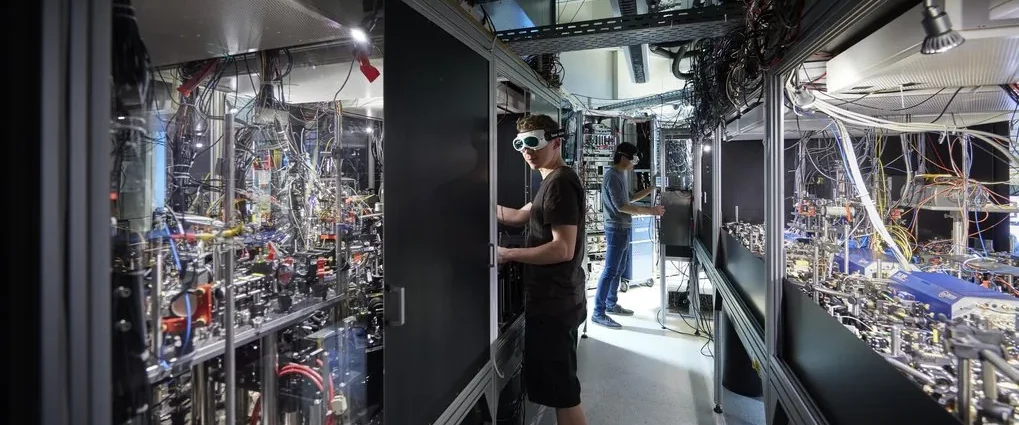
How does complex quantum many-body behaviour emerge from interactions between individual atoms?
Our research
At the heart of our experiment is a quantum gas microscope that allows us to observe and control individual atoms in an optical lattice. By combining different lattice geometries with tunable short- and long-range interactions, we can engineer a wide variety of quantum many-body systems comprising up to 1,500 atoms. This level of microscopic control enables us to explore complex quantum phenomena, ranging from strongly correlated many-body dynamics and quantum magnetism to Rydberg physics and cooperative light–matter interactions.
A switchable mirror one atom thick
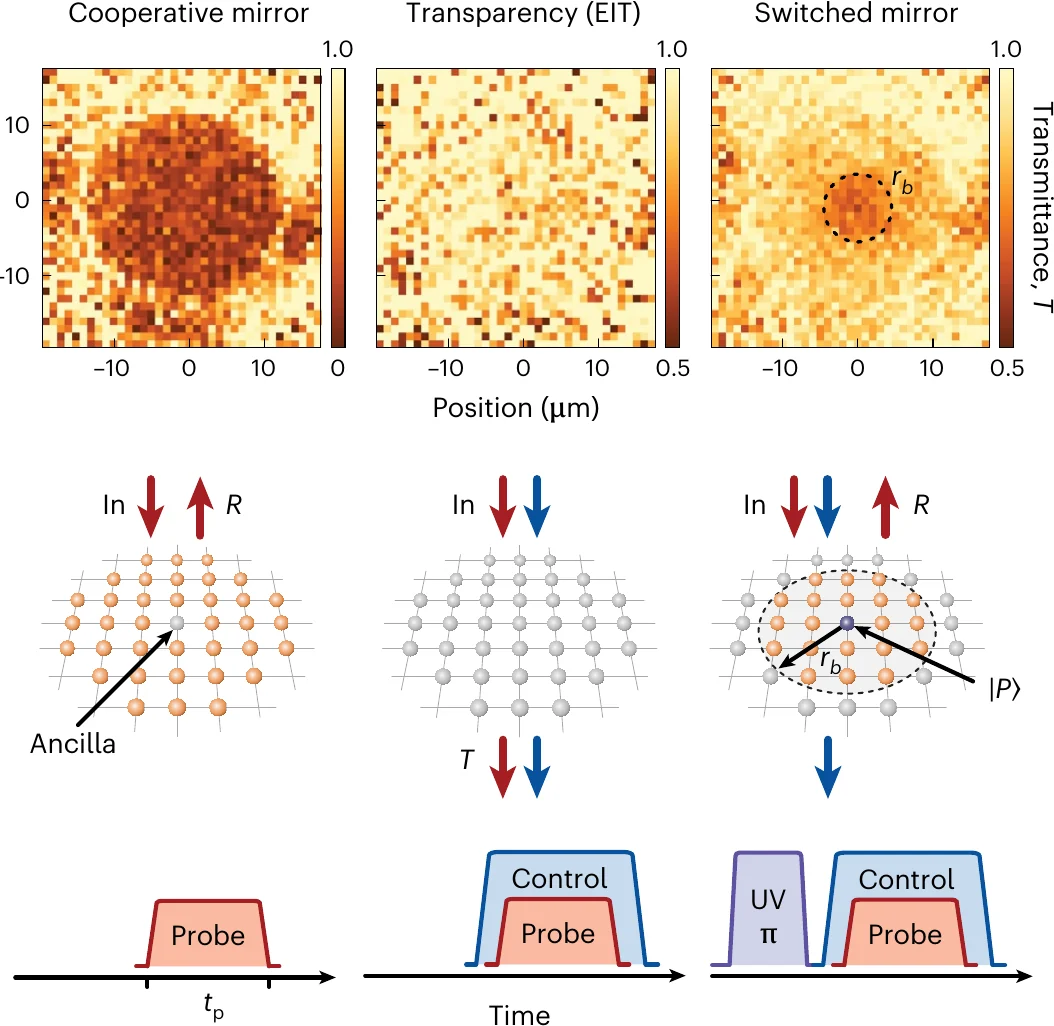
Atoms spaced closer than the wavelength of light scatter it collectively, so a two-dimensional Mott insulator of up to 1,500 atoms acts as an atomically thin mirror. We excited a single ancilla atom at its centre to a Rydberg state. A control laser admixes a small Rydberg fraction to the mirror, which interacts strongly with the ancilla, so the ancilla switches the array between transmission and reflection. Rabi oscillations of the ancilla gave coherent control of both.
 Enlarge (opens the full-size figure)
Constrained dynamics and programmable lattices
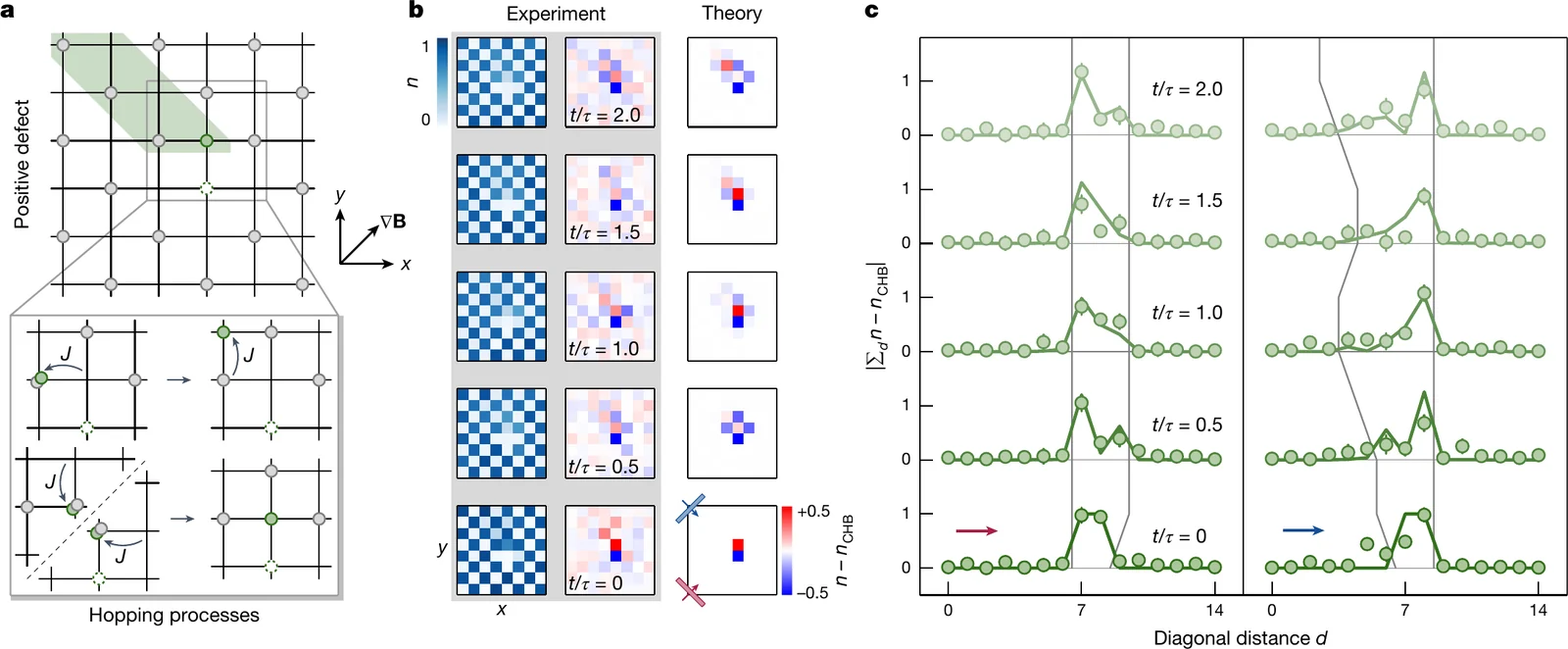
In a lattice tilted so that the energy step between neighbouring sites equals the on-site interaction, atoms can only move in correlated ways. These kinetic constraints fragment the Hilbert space into disconnected sectors in which thermalisation can be strongly suppressed. Chequerboard, dimer and other patterns with equal particle number and energy relaxed very differently. A defect made by displacing one chequerboard atom by one site moved only along a narrow stripe and in one direction, a signature of fractons.
 Enlarge (opens the full-size figure)
Extended-range interactions from Rydberg dressing
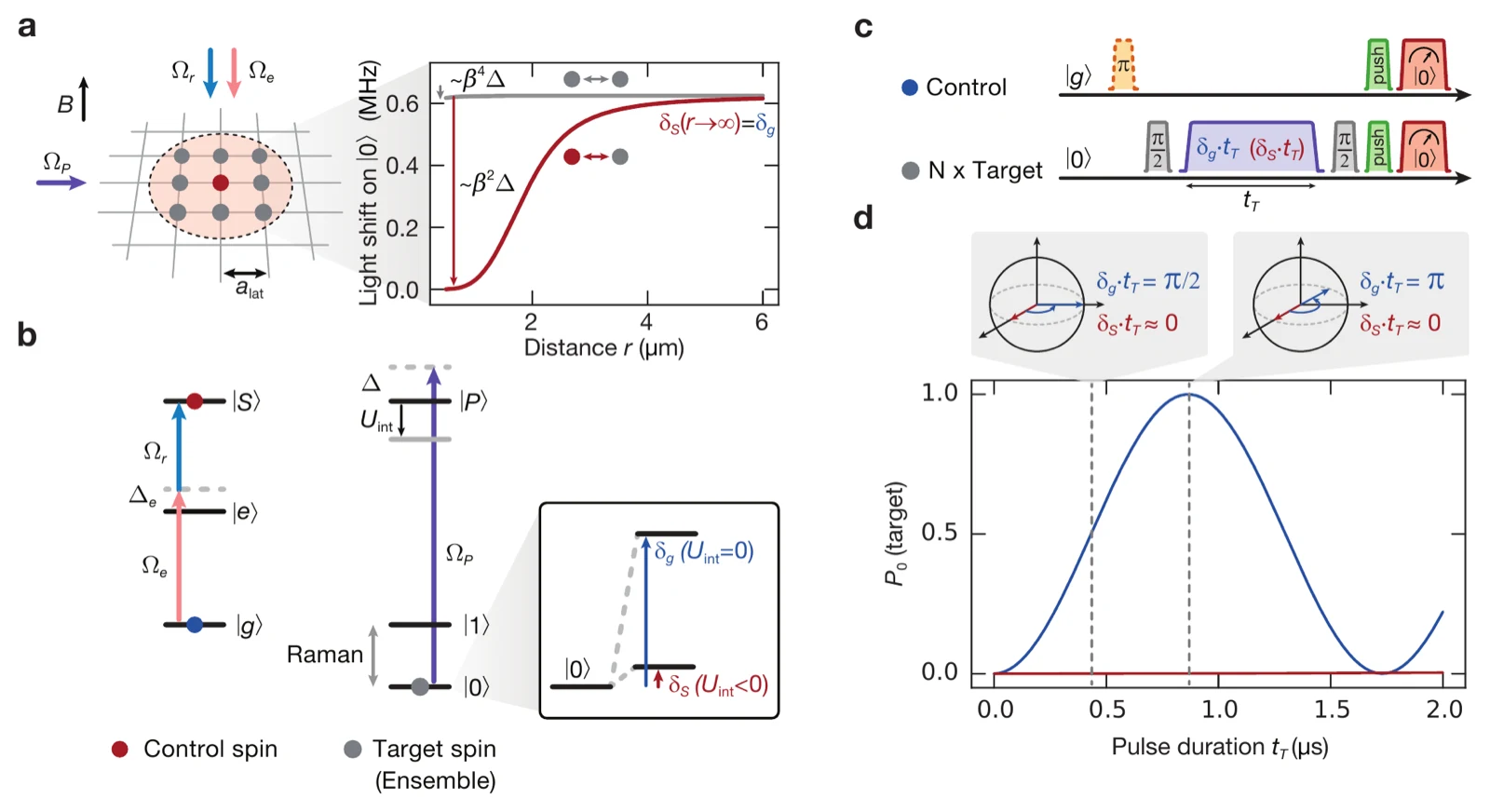
Off-resonant laser coupling to a Rydberg state lends ground-state atoms part of the strong Rydberg interaction, with a range of up to a few lattice sites. Collective losses had limited this Rydberg dressing. Short light pulses gave lifetimes above 100 ms, about a hundred times longer than in earlier experiments, and we realised an effective one-dimensional extended Bose-Hubbard model. We followed repulsively bound pairs and kinetically constrained hard rods, and saw the onset of density order when the interactions were ramped up slowly.
In a 2026 preprint, a control atom stores a qubit in its ground and Rydberg states and imprints a collective phase on a Rydberg-dressed ensemble of up to eight surrounding atoms. Reading out the ensemble detected a single Rydberg excitation without destroying it, with a state-assignment fidelity above 98 %.
 Enlarge (opens the full-size figure)
Research directions
Next we want to explore further many-body states with light-controlled extended-range interactions, using larger lattice spacings and longer-lived Rydberg states. Collective phase imprinting opens a route to non-destructive mid-circuit readout of Rydberg states and to interfaces between single qubits and photonic modes. Negative-temperature states give access to an antiferromagnetic bosonic t-J model in a staggered field (2024 preprint), which we plan to use to study individual charge carriers and finite doping.
Selected results & publications
Realization of a Rydberg-dressed extended Bose Hubbard modelScience 390, 849–853 (2025) · Journal ArticleObservation of Hilbert space fragmentation and fractonic excitations in 2DNature 636, 80–85 (2024) · Journal ArticleA subwavelength atomic array switched by a single Rydberg atomNature Physics 19, 714–719 (2023) · Journal ArticleObservation of Brane Parity Order in Programmable Optical LatticesPhysical Review X 13, 021042 (2023) · Journal ArticleMicroscopy of bosonic charge carriers in staggered magnetic fieldsarXiv:2410.19500 (2024) · PreprintResearch with this team
Discuss student projects, doctoral research or postdoctoral opportunities with the scientific contact; project scope and availability are agreed individually.
Methods and topics: Quantum gas microscopy, Rydberg excitation, Light–matter interactions.
Explore research opportunities