From the group

News.

Research results, awards, thesis defences and other announcements from the group since 2018.

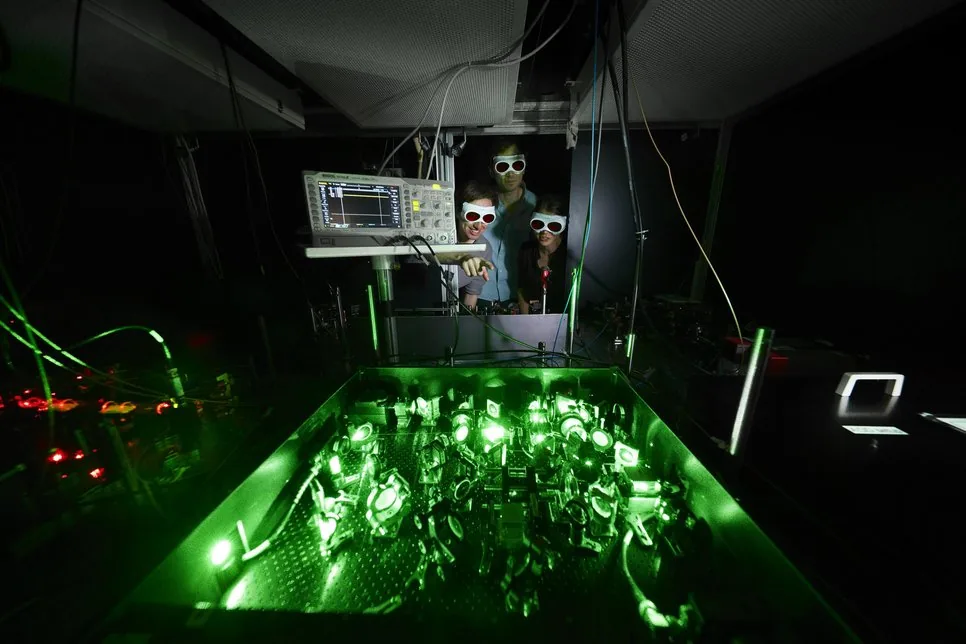
A glimpse into the lithium lab set-up at the Max Planck Institute of Quantum Optics.
© Max-Planck-Institut für Quantenoptik

Research highlight 23 January 2026

A closer look at the pseudogap.

Quantum gas microscopy reveals a shared temperature scale in spin and charge correlations of the Fermi–Hubbard model.

Read the story

The archive

110 stories

Group life

Congratulations to Naman Jain on his PhD!

Naman Jain successfully defended his PhD thesis, “Assembling fermionic quantum matter atom by atom: a ⁶Li tweezer-array quantum gas microscope.” Congratulations, Naman!


Group life

Congratulations to Andreas von Haaren on his PhD!

We are delighted to celebrate Andreas von Haaren's successful PhD defense of his thesis, "A New ⁶Li Quantum Gas Microscope with Hz-Scale Repetition Rate.” Congratulations Andreas on this remarkable achievement! We wish you all the very best and every success in your future endeavors.

Group life

Congratulations to Shrestha Biswas on her PhD!

We are delighted to celebrate Shrestha Biswas’s successful PhD defense of her thesis, "Double microwave-shielded fermionic polar molecules." We congratulate Shrestha on this outstanding achievement and wish her continued success in her future career.

Awards

Si Wang receives Best Poster Award at PAQ 2026

Si Wang received a Best Poster Award at Pure and Applied Quantum (PAQ 2026), a satellite conference of the 29th International Conference on Atomic Physics, held in Beijing in June 2026.

Group life

Maximilian successfully defended his PhD Thesis!

Maximilian Ammenwerth successfully defended his PhD Thesis “Fast Multi-Photon Single-Qubit Operations in Arrays of Strontium Atoms” We warmly congratulate you Maximilian and wish you all the best for your future.

Group life

Prof. Cheng Chin visits our group

Prof. Cheng Chin from the University of Chicago, a Humboldt Research Award winner, visited the Quantum Many-Body Systems Division twice during his sabbatical, from 21 September to 20 October 2025 and from 19 January to 18 March 2026.

Group life

Robin successfully defended his PhD Thesis!

Robin Eberhard successfully defended his PhD Thesis “Quantum Control and Computing with Neutral ⁸⁸Sr Atoms” We warmly congratulate you Robin and wish you all the best for your future.

Group life

Alexander Hesse successfully defended his PhD thesis!

Alexander Hesse successfully defended his PhD Thesis “Probing disorder-driven topological phase transitions via topological edge modes in Floquet-engineered honeycomb lattices”. We warmly congratulate you Alexander and wish you all the best for your future.

Group life

Petar successfully defended his PhD Thesis!

Petar Bojović has successfully defended his PhD Thesis “Fermi-Hubbard Quantum Gas Microscope: Analog Simulation and Digital Gates”. We warmly congratulate you Petar and wish you all the best for the future.

Group life

Renhao successfully defended his PhD Thesis!

Renhao Tao has successfully defended his PhD Thesis “Scalable neutral-atom arrays and high-fidelity universal quantum gates on metastable qubits.” Congratulation Renhao! We wish you all the best for the future.

Group life

Prof. Norman Yao

Prof. Norman Yao from the Department of Physics, Harvard University, Cambridge, USA, is visiting the Max Planck Institute of Quantum Optics from and the LMU Municht from June 9 to July 31, 2025.

Group life

Alexander Impertro successfully defended his PhD thesis!

Alexander Impertro has successfully defended his doctoral thesis “Quantum Gas Microscopy of Interacting Quantum Matter with Artificial Gauge Fields”. We warmly congratulate Alexander and wish him continued success in his scientific endeavours.

Group life

Valentin successfully defended his PhD Thesis!

Valentin Klüsener has successfully defended his doctoral thesis on “Microscopy and Precision Spectroscopy for Quantum Science with Ultracold Strontium.” We warmly congratulate you Valentin and wish you all the best for the future.

Group life

Annual Group Retreat

This year’s group retreat at Schloss Ringberg, Lake Tegernsee

Research

Superlattices under the microscope

One of the most promising paths in the field of quantum simulation consists in studying interacting ultracold atoms in optical lattices, thus realizing the famous Hubbard model mimicking the behavior of interacting electrons in solids. Such an approach is particularly powerful when combined with the technique of quantum gas microscopy, which allows to “see” individual particles and explore microscopic correlations between them.

Research

Local Readout and Control of Current and Kinetic Energy Operators in Optical Lattices

Using quantum gas microscopes, the wavefunction of a quantum system can be probed with microscopic resolution through projective measurements. By nature of the optical imaging techniques that are used to implement these measurements, the observable that is probed is the local density operator -- each atom in the underlying lattice geometry appears as a bright dot in the recorded image.

Research

Real-space detection and manipulation of topological edge modes with ultracold atoms

Topological materials, in contrast to "ordinary" materials host edge modes which enable dissipation-free transport along the system's boundary. The transport enabled by the edge mode is robust to imperfections of the crystal and small variations of the system parameters - it is topologically protected. This protection of the edge mode is intriguing, as small variations in the system do not alter the conductance of the edge mode, a phenomenon famously observed in the quantum Hall effect and used in the redefinition of the International System of Units (SI) units in 2019. Directly observing this edge transport is intriguing,

Research

Fine-Structure Qubit Encoded in Metastable Strontium Trapped in an Optical Lattice

There are three promising candidates for high-quality qubits in two-electron atoms. First, a valence electron can be excited on an ultranarrow optical transition (clock qubit). Second, the spin of the nucleus can be excited using Raman or microwave transitions (nuclear qubit). Third, the spin of the valence electron can be flipped (fine-structure qubit).

Research

A detailed look into the 2D SU(N) Fermi-Hubbard Model

One of the important elements at the core of physics is the symmetry of a physical system. This can be a classical "left-right"-symmetry that we all know from everyday life, but also a symmetry that is expressed in other, more unusual properties. On fundamentally "quantum" property is the quantum "spin", which describes a kind of internal rotation of an object which only exists in quantum mechanics.

Group life

Christoph Braun has successfully defended his dissertation!

Christoph Braun has successfully defended his dissertation on the topic "Real-space detection and manipulation of topological edge modes with ultracold atoms". Congratulations to Christoph and all the best for his future!

Research

Ultracold field-linked tetratomic molecules

Ultracold polyatomic molecules offer intriguing new opportunities in cold chemistry, precision measurements, and quantum information processing, thanks to their rich internal structure. However, their increased complexity compared to diatomic molecules presents a formidable challenge to employ conventional cooling techniques.

Group life

Xing-yan successfully defended his PhD thesis!

Xing-yan Chen has successfully defended his doctoral thesis on “Microwave-shielded ultracold polar molecules”. We warmly congratulate you Xing-yan and wishyou all the best for the future.

Group life

David successfully defended his PhD thesis!

David Wei has successfully defended his doctoral thesis on “Microscopy of spin hydrodynamics and cooperative light scattering in atomic Hubbard systems”. We warmly congratulate you David and wish you all the best for the future.

Awards

Maximilian won best poster award

Maximilian Ammenwerth won a best poster award at the Applications of Ultracold Rydberg Gases conference with his poster presentation about "Individual Strontium Atoms in a Hybrid Lattice-tweezer Quantum Simulator"

Group life

Giulio successfully defended his PhD thesis!

Giulio Pasqualetti successfully defended his doctoral thesis on “Probing the thermodynamics of SU(N)-symmetric Fermi gases with ultracold atoms” on July 21st, 2023. We warmly congratulate you Giulio and wish you all the best for the future.

Research

Observation of Brane Parity Order in Programmable Optical Lattices

The Mott-insulating phase of the two-dimensional (2D) Bose-Hubbard model is expected to be characterized by a nonlocal brane parity order. Parity order captures the presence of microscopic particle-hole fluctuations and entanglement, whose properties depend on the underlying lattice geometry.

Group life

Johannes Zeiher in "People at the MPQ"

Johannes and his work was featured in the “The people at MPQ” on the MPQ Website. Go ahead and read the complete article to learn more about his scientific past, his research interests and plans for the future.

Group life

Lab Day at MPQ

On March 17th, we organized an open house at MPQ to show interested master students our labs. The event started off with a presentation introducing the work done in the Many Body Systems Division by Immanuel Bloch, followed by lab tours in the Single Atoms lab, the Molecules lab and the Strontium lab.

Research

A subwavelength atomic array switched by a single Rydberg atom

Enhancing light–matter coupling at the level of single quanta is essential for numerous applications in quantum science. The cooperative optical response of subwavelength atomic arrays has been found to open new pathways for such strong light–matter couplings, while simultaneously offering access to multiple spatial modes of the light field.

Research

Field-linked resonances of polar molecules

Scattering resonances are an essential tool for controlling interactions of ultracold atoms and molecules. However, conventional Feshbach scattering resonances, which have been extensively studied in various platforms, are not expected to exist in most ultracold polar molecules due to the fast loss that occurs when two molecules approach at a close distance. Here, we demonstrate a new type of scattering resonances that is universal for a wide range of polar molecules.

Research

Magnetically mediated hole pairing in fermionic ladders of ultracold atoms

Conventional superconductivity emerges from pairing of charge carriers – electrons or holes – mediated by phonons. In many unconventional superconductors, the pairing mechanism is conjectured to be mediated by magnetic correlations, as captured by models of mobile charges in doped antiferromagnets.

Research

Ultracold Sticky Collisions: Theoretical and Experimental Status

Collisional complexes, which are formed as intermediate states in molecular collisions, are typically short-lived and decay within picoseconds. However, in ultracold collisions involving bialkali molecules, complexes can live for milliseconds, completely changing the collision dynamics. This can lead to unexpected two-body loss in samples of nonreactive molecules.

Group life

Bloch Christmas Party 2022

With a wonderful buffet of homemade savory and sweet dishes from all over the world, our division celebrated its annual Christmas party on December 15, 2022.

Group life

Hendrik successfully defended his PhD thesis!

Hendrik von Raven successfully defended his doctoral thesis on "A new Caesium quantum gas microscope with precise magnetic field control” on September 27th, 2022.

Awards

Immanuel Bloch named Clarivate Citation Laureate

Immanuel is one of 20 scientists to be named this year's Clarivate Citation Laureate, being one of four recipients in the physics category to receive the award for his "ground-breaking research on quantum many-body systems using ultracold atomic and molecular gases, opening the way to quantum simulations of 'artificial solids'".

Research

Evaporation of microwave-shielded polar molecules to quantum degeneracy

Ultracold polar molecules offer strong electric dipole moments and rich internal structure, which makes them ideal building blocks to explore exotic quantum matter, implement novel quantum information schemes, or test fundamental symmetries of nature. Realizing their full potential requires cooling interacting molecular gases deeply into the quantum degenerate regime.

Research

Cavity-Enhanced Optical Lattices for Scaling Neutral Atom Quantum Technologies to Higher Qubit Numbers

We demonstrate a cavity-based solution to scale up experiments with ultracold atoms in optical lattices by an order of magnitude over state-of-the-art free-space lattices. Our two-dimensional (2D) optical lattices are created by power-enhancement cavities with large mode waists of 489(8)μm and allow us to trap ultracold strontium atoms at a lattice depth of 60μK by using only 80mW of input light per cavity axis.

Research

Quantum computing startup "planqc" founded to build highly scalable quantum computer

planqc will develop a highly scalable quantum computer operating at room temperature and based on atoms trapped in optical lattices. planqc is building quantum computers that store information in individual atoms – nature's best qubits. Quantum information is processed by arranging these qubits in highly scalable arrays and manipulating them with precisely controlled laser pulses. planqc’s unique combination of quantum technologies is the fastest way to scale to thousands of qubits, a prerequisite for industry-relevant quantum advantage.

Research

Quantum gas microscopy of Kardar-Parisi-Zhang superdiffusion

The Kardar-Parisi-Zhang (KPZ) universality class describes the coarse-grained behavior of a wealth of classical stochastic models. Surprisingly, KPZ universality was recently conjectured to also describe spin transport in the one-dimensional quantum Heisenberg model.

Research

Realizing distance-selective interactions in a Rydberg-dressed atom array

Exciting ultracold atoms into highly-excited Rydberg states extends the cold atom toolbox by long-range interactions. Rydberg macrodimers - electrostatically bound Rydberg atom pairs - provide bond lengths as large as the distances between different lattice sites in an optical lattice. Optical excitation rates of macrodimers are enhanced if the distance and orientation of the prepared ground state atom pairs match the motional state of the macrodimer state and are suppressed otherwise.

Group life

Annie successfully defended her PhD thesis!

Annie Park successfully defended her doctoral thesis on "Towards Quantum Simulations with Strontium in Cavity-enhanced Optical Lattices” on December 21st, 2021.

Research

Observing non-ergodicity due to kinetic constraints in tilted Fermi-Hubbard chains

It has been predicted that even in the absence of disorder many-body systems may fail to thermalize. In this work we observe non-ergodic dynamics in the 1D tilted Fermi-Hubbard model that is distinct from previously studied regimes, and propose a microscopic mechanism that is due to emergent kinetic constraints.

Research

Collisions of ultracold molecules in bright and dark optical dipole traps

What happens when two molecules collide with each other? This seemingly simple question remains unanswered in many cases. Specifically, when two molecules collide in such a way that chemical reactions are impossible due to energy and momentum conservation, one would expect that the molecules remain unchanged.

Research

Microscopic electronic structure tomography of Rydberg macrodimers

Precise control and study of molecules is challenging due to the variety of internal degrees of freedom and local coordinates that are typically not controlled in an experiment. Employing quantum gas microscopy to position and resolve the atoms in bound states of Rydberg atom pairs --- so-called Rydberg macrodimers --- solves most of these challenges and enables unique access to the molecular frame.

Awards

Thomas Chalopin receives Humboldt Research Fellowship

In recognition of his previous scientific work, the Selection Committee of the Humboldt foundation has awarded Thomas Chalopin with the Humboldt Research Fellowship for Postdoctoral Researchers.

Group life

Sebastian successfully defended his PhD thesis

Sebastian Scherg successfully defended his doctoral thesis on "Probing nonequilibrium dynamics in Fermi-Hubbard chains - from extensively-many to few conserved quantities " on January 28th, 2021. We warmly congratulate you Sebastian and wish you all the best for your future!

Group life

Karen Wintersperger successfully defended her PhD thesis

Karen Wintersperger successfully defended her doctoral thesis on "Realization of Floquet topological systems with ultracold atoms in optical honeycomb lattices" on September 23th, 2020. We warmly congratulate you Karen Wintersperger and wish you all the best for your future!

Research

A subradiant optical mirror formed by a single structured atomic layer

Versatile interfaces with strong and tunable light–matter interactions are cornerstones for quantum science as they enable the mapping of quantum properties between light and matter. Single atoms are ideal quantum emitter of the light fields, as their only possible dissipation channel is the coupling to the electromagnetic vacuum.

Group life

André Heinz successfully defended his PhD thesis

André Heinz successfully defended his doctoral thesis on "Ultracold Strontium in State-Dependent Optical Lattices" on June 26th, 2020. We warmly congratulate you André Heinz and wish you all the best for your future!

Research

Realization of an anomalous Floquet topological system with ultracold atoms

Topological phases of matter have attracted a lot of interest due to their unique electronic properties that often result in exotic surface or boundary modes, whose existence is rooted in the non-trivial topological properties of the underlying system. In particular, the robustness of these properties makes them interesting for applications.

Research

Floquet Prethermalization in a Bose-Hubbard System

The periodic driving of both classical and quantum systems can reveal new phenomena without an analog in non-driven systems. Nonetheless, periodically driven systems do not fulfill energy conservation, which means that many-body systems will absorb energy from the drive and, eventually, heat up to an arbitrarily high temperature, what is known as "heat death".

Awards

Dr. Cesar Cabrera receives ICFO PhD Thesis Award

In recognition of his exceptional thesis: “Quantum Liquid Droplets in a Mixture of Bose-Einstein Condensates” Cesar Cabrera received the ICFO PhD Thesis award in December 2019 at the ICFO Institute in Spain.

Research

Time-resolved observation of spin-charge deconfinement in fermionic Hubbard chains

Elementary particles carry several quantum numbers, such as charge and spin. However, in an ensemble of strongly interacting particles, the emerging degrees of freedom can fundamentally differ from those of the individual constituents. For example, one-dimensional systems are described by independent quasiparticles carrying either spin (spinon) or charge (holon).

Research

Rubidium lab featured in PHYSIKonkret of DPG

The Rubidium lab and its research was featured in PHYSIKonkret, an information leaflet of the German physical society (DPG), that contains current scientific and science policy topics.

Research

Many-Body Delocalization in the Presence of a Quantum Bath

Some isolated quantum systems with disordered potentials fail to ever reach thermal equilibrium, a phenomenon known as many-body localization (MBL). An outstanding question concerns the stability of this phenomenon. While it is well known that exposing the quantum system to the outside world destroys localization, it is not clear what happens when the MBL system is connected to another small quantum system known as a quantum bath.

Research

Floquet approach to Z2 lattice gauge theories

Strongly-interacting gauge theories are extremely challenging to access with conventional numerical techniques. Here, we take a first step towards quantum simulation of gauge theories by implementing a Floquet-based method with two-component ultracold bosons in a double-well potential.

Research

Imaging magnetic polarons in the doped Fermi-Hubbard model

Here we report the microscopic real-space characterization of magnetic polarons in a doped Fermi–Hubbard system, enabled by the single-site spin and density resolution of our ultracold-atom quantum simulator. We reveal the dressing of doublons by a local reduction—and even sign reversal—of magnetic correlations, which originates from the competition between kinetic and magnetic energy in the system.

Research

Quantum gas microscopy of Rydberg macrodimers

Typically, direct optical access to molecular constituents is out of reach due to their tiny size in the sub-nanometer regime. Because highly-excited Rydberg atoms feature strong interactions even at distances of micrometers, two Rydberg atoms can form huge molecules, comparable to the size of small bacteria and larger than optical wavelengths.