

How can large, continuously refilled arrays of strontium atoms become programmable quantum processors?
The platform
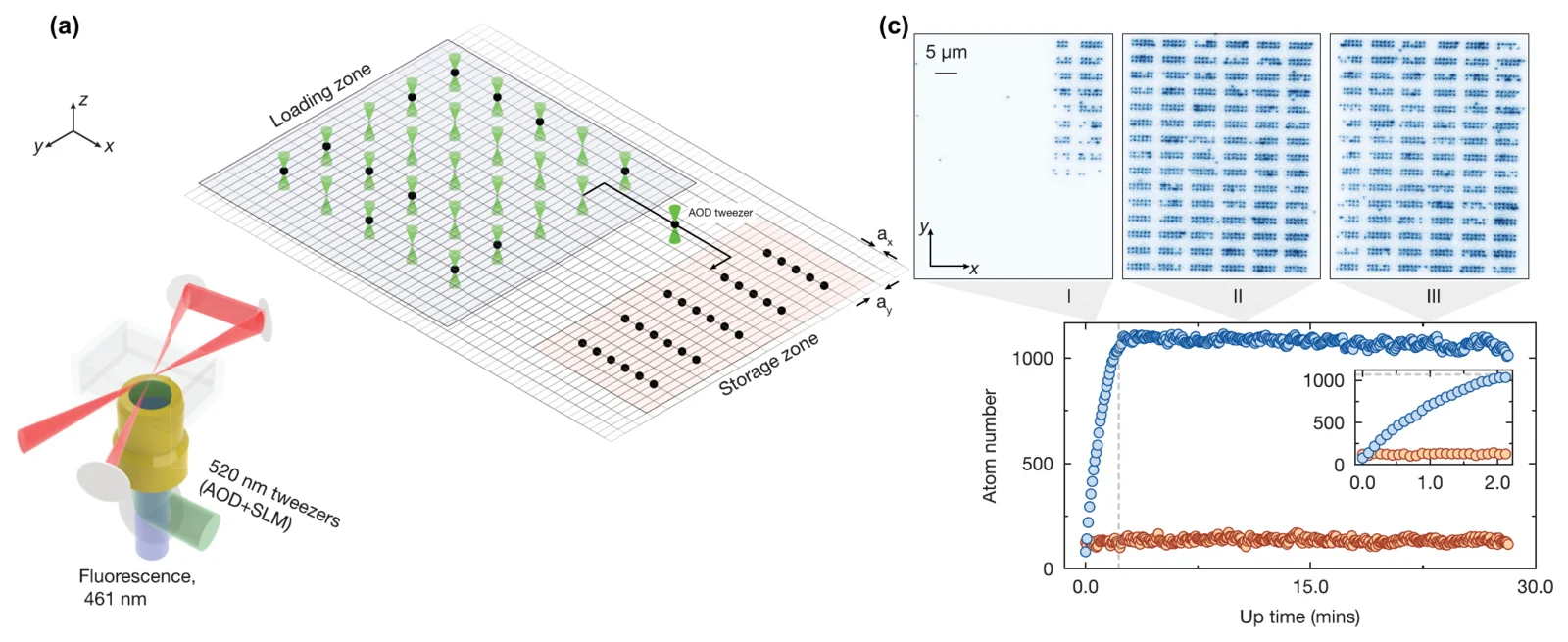
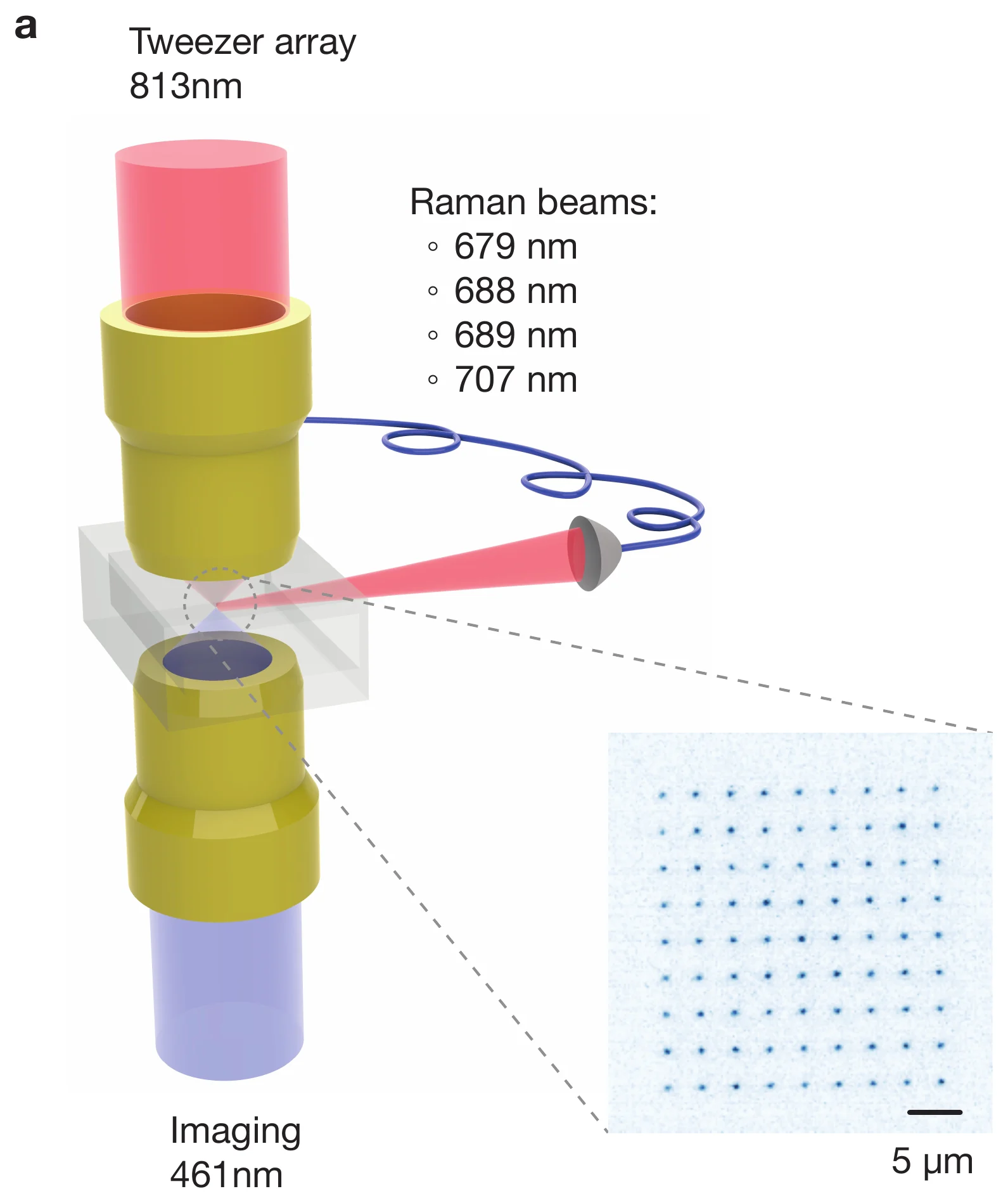
We work with bosonic ⁸⁸Sr. A 1040 nm bow-tie optical lattice with spacings of 579 nm and 1187 nm stores large arrays. A spatial light modulator creates static tweezer arrays at 520 nm or 813 nm, and mobile tweezers steered by acousto-optic deflectors sort and transport single atoms. We image the atoms by fluorescence at 461 nm while cooling them on the narrow 689 nm line. Lasers drive transitions between the ground state and the metastable ³P₀ and ³P₂ clock states, and 316 nm ultraviolet light couples ³P₀ to a Rydberg state for entangling gates.
Large arrays in continuous operation
Narrow optical lines in strontium allow Sisyphus cooling while the atoms scatter imaging light. We showed that this works even when the ground state is trapped more deeply than the excited state. Atoms in the lattice were detected with 99.971(1) % fidelity and 99.80(5) % survival, and we transferred them repeatedly between the lattice and up to 399 tweezers.
Rebuilding a large array for every run is slow. We therefore keep the stored atoms from one run to the next and replace only those that were lost, using a separate loading zone. We held more than 1000 atoms in the lattice, reloaded about 130 atoms in each 3.5 s cycle and kept an array running for more than 1.5 hours.
 Enlarge (opens the full-size figure)
A qubit in the fine structure of strontium
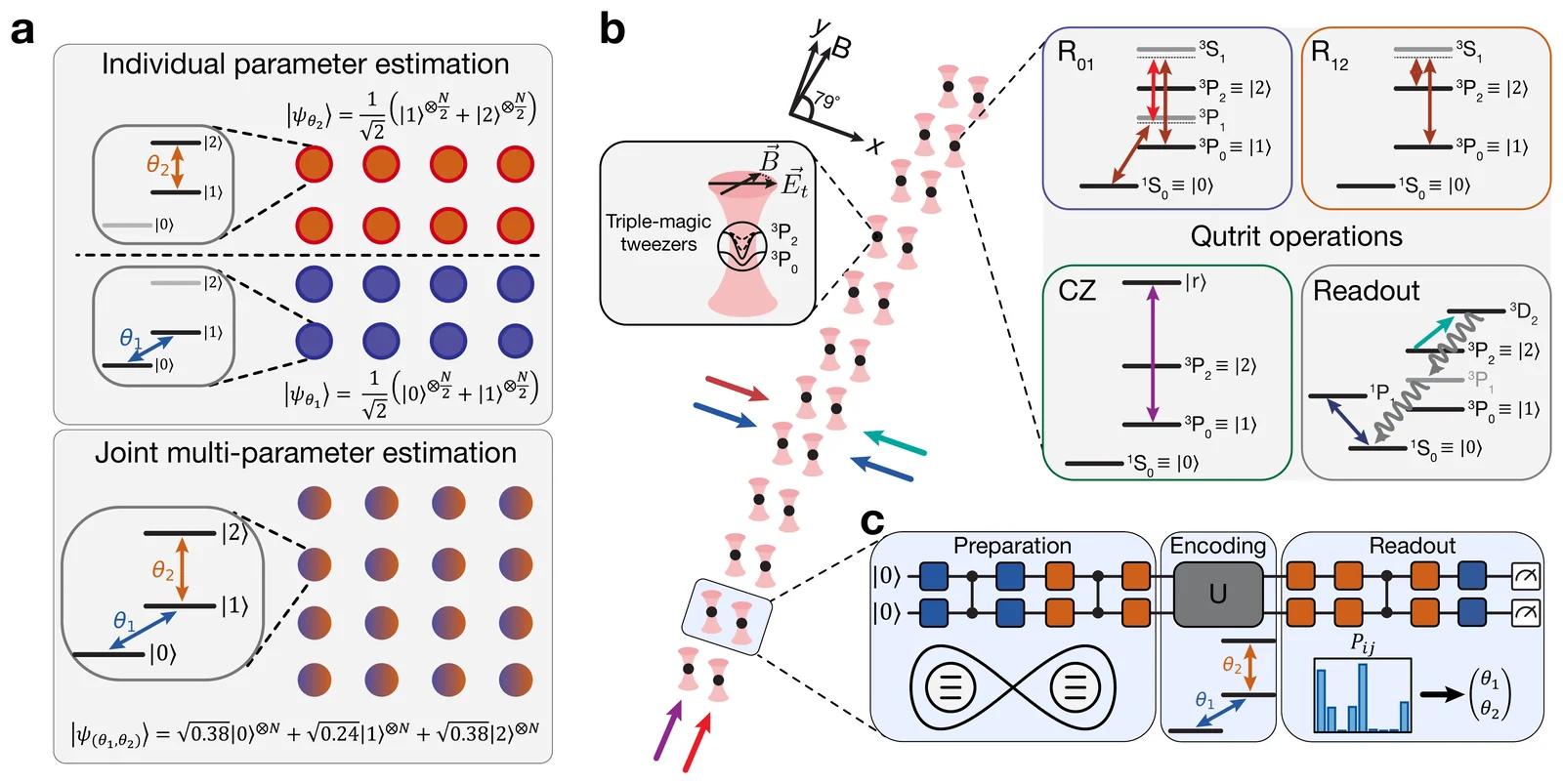
The metastable clock states ³P₀ and ³P₂ form a fine-structure qubit, and the ground state adds a third level. At a chosen angle between the magnetic field and the tweezer polarisation, 813 nm tweezers trap all three states equally. Under these triple-magic conditions we drove fast two- and three-photon transitions between all three states and found an atom-atom coherence time between the two metastable states of 715(30) ms.
On this qubit we demonstrated a universal gate set. Single-qubit gates, driven by global Raman beams, reach an average fidelity of 0.993(1) after erasure conversion. Two-qubit gates based on Rydberg blockade reach 0.9945(6) after correcting for losses during the gate. Because the ground state lies outside the qubit, fast destructive mid-circuit imaging converts leakage into the ground state into detectable erasures.
 Enlarge (opens the full-size figure)
Velocity as a resource
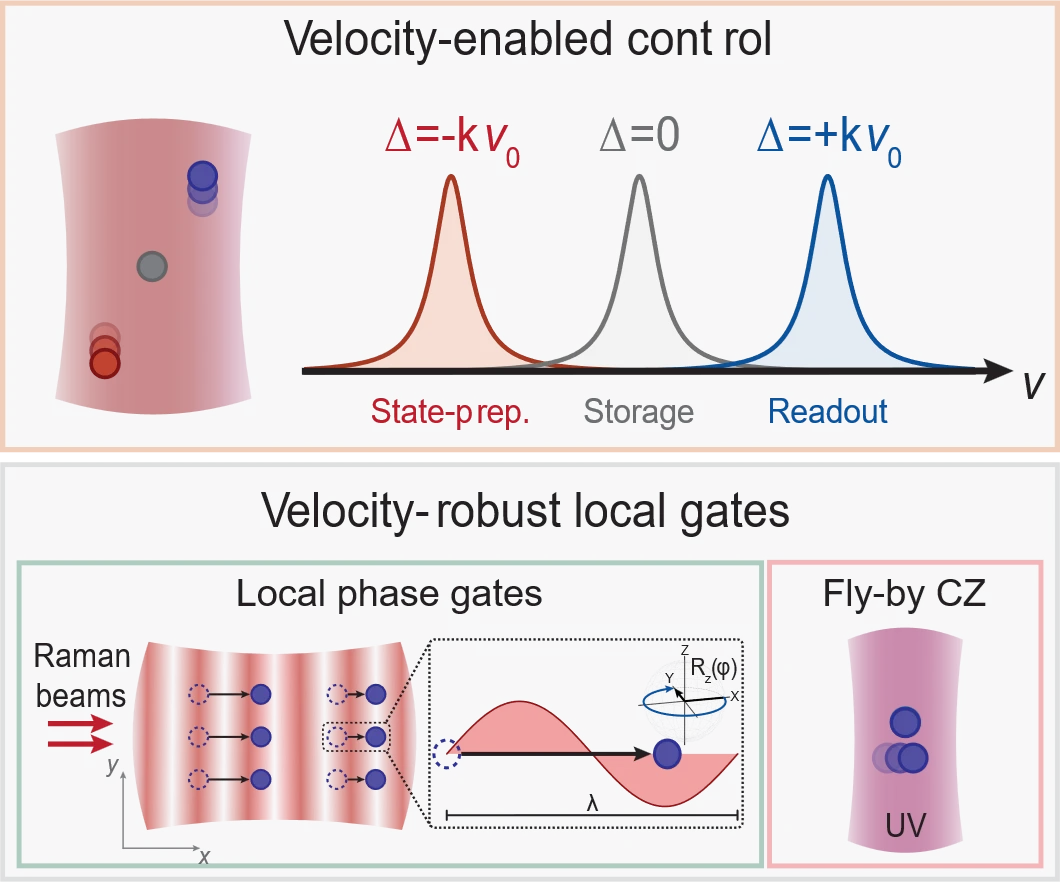
In a 2026 preprint we use the velocity of moving atoms for control. Through the Doppler shift, a global laser prepares and measures only atoms moving at a chosen speed and leaves stationary atoms untouched. With CZ gates of 99.86(4) % fidelity after excising detected atom loss, we generated an eight-qubit cluster state and a [[4,2,2]] error-detection code with 99.0(3) % logical Bell-state fidelity after error detection.
 Enlarge (opens the full-size figure)
Entangled qutrits for sensing
In a second 2026 preprint we use all three levels. We prepared a maximally entangled state of two qutrits with a loss-postselected fidelity of 0.85(1) and estimated two injected phases on two optical clock transitions at once, with a joint variance below the ideal limit for separate two-level sensing.
 Enlarge (opens the full-size figure)
Research directions
We aim to run fine-structure qubits and fly-by gates on moving atoms in large, continuously refilled arrays, keeping the qubits coherent while new atoms are loaded. Rydberg interactions in these arrays could also serve to simulate Ising spin models.
Selected results & publications
Qutrit entanglement and joint multi-parameter estimation in an optical clock platformarXiv:2608.05426 (2026) · PreprintUniversal Global Gates for a Fine-Structure Qubit in Strontium-88Physical Review Letters 136, 153602 (2026) · Journal ArticleRealization of a Fast Triple-Magic All-Optical Qutrit in 88SrPhysical Review Letters 135, 143401 (2025) · Journal ArticleContinuous operation of large-scale atom arrays in optical latticesPhysical Review Research 6, 033104 (2024) · Journal ArticleHigh-fidelity detection of large-scale atom arrays in an optical latticePhysical Review Letters 133, 013401 (2024) · Journal ArticleVelocity-Enabled Quantum Computing with Neutral AtomsarXiv:2603.15561 (2026) · PreprintResearch with this team
Discuss student projects, doctoral research or postdoctoral opportunities with the scientific contact; project scope and availability are agreed individually.
Methods and topics: Optical lattices and tweezers, Rydberg excitation, Coherent control.
Explore research opportunities