How can controlled motion and collisions turn a fermionic quantum simulator into a programmable processor?
The platform
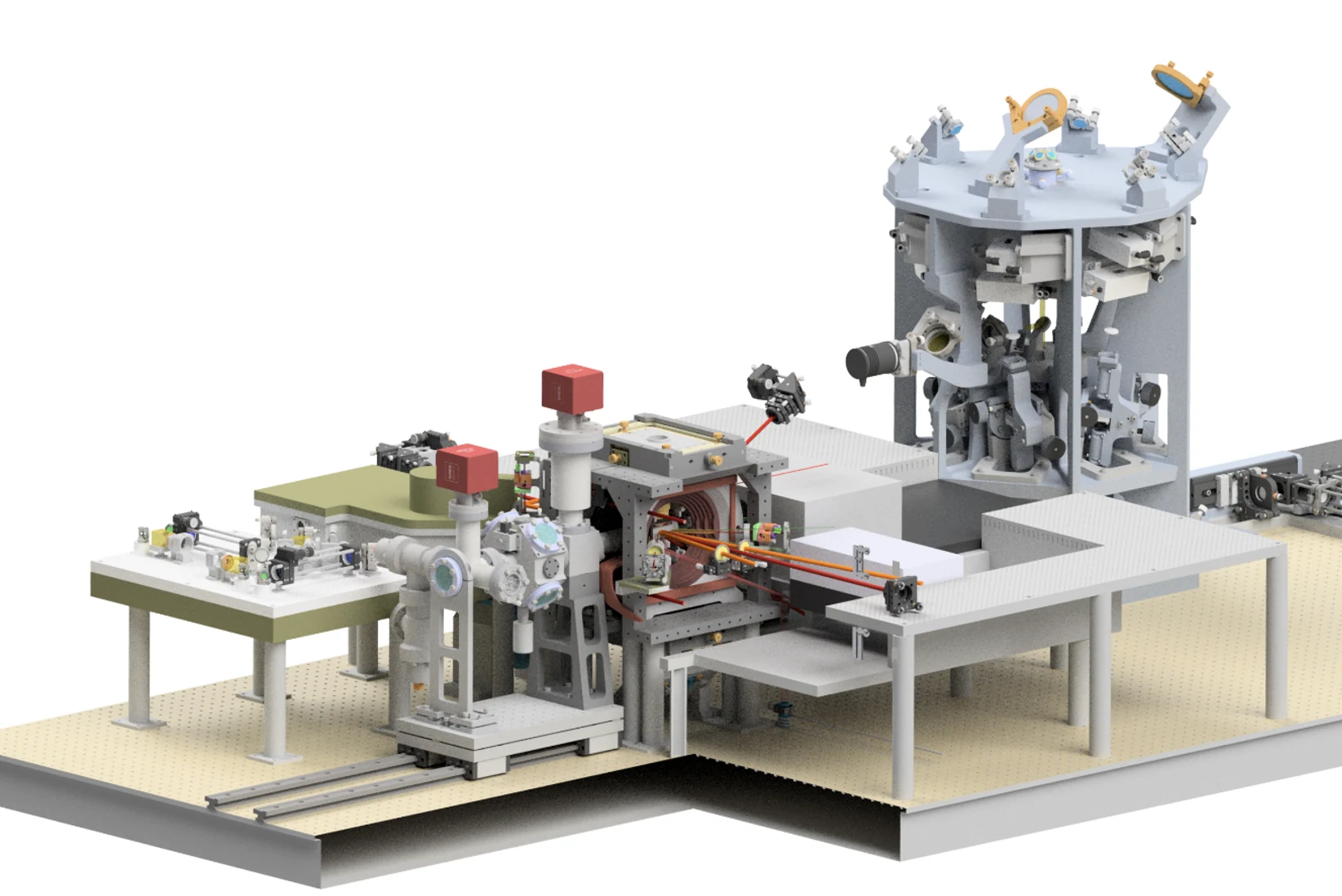
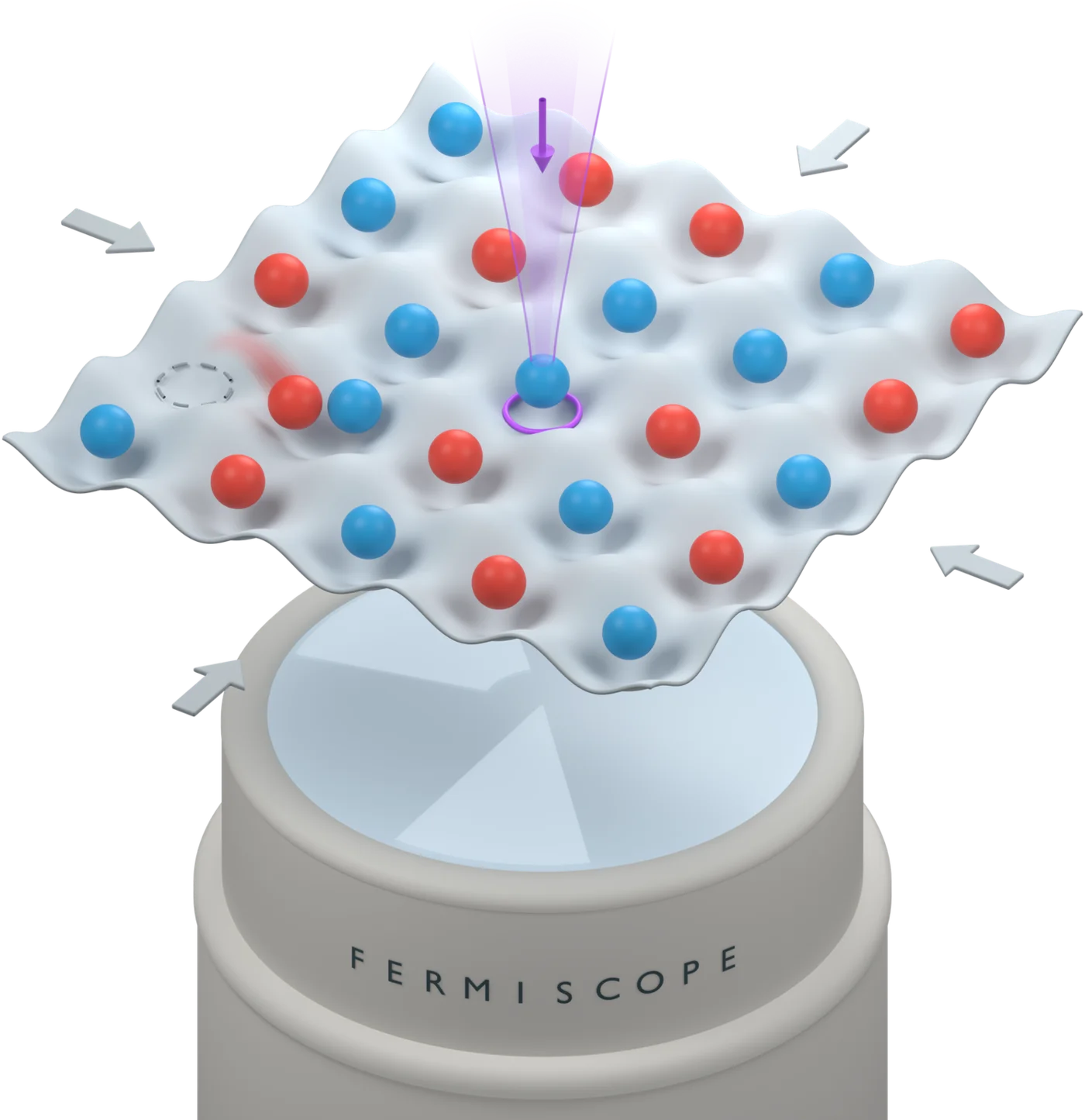
FermiQP is a joint project funded by the German Federal Ministry of Research, Technology and Space (BMFTR). Its processor is designed to run in two modes. In the analogue mode, ultracold fermionic ⁶Li atoms in an optical lattice simulate the Fermi-Hubbard model and a quantum gas microscope reads them out site by site. In the digital mode, controlled collisions in an optical superlattice act as global two-qubit gates, combined with laser-driven control of individual spins. Our group builds the demonstrator, with partners in Tübingen, Munich, Jülich, Berlin, Jena and industry.
 Enlarge (opens the full-size figure)
One machine, two modes
Conventional quantum computers use qubits, which do not obey fermionic statistics. To simulate electrons, the exchange statistics of fermions must first be translated into qubit operations, and this adds computational cost. FermiQP is designed to compute with fermionic atoms directly. At its start in 2021 the project targeted about 1,000 to 10,000 atoms in the analogue mode and about 200 fully connected qubits in the digital mode. Digital gate sequences then prepare the initial state of an analogue simulation and set its readout basis.
 Enlarge (opens the full-size figure)
Collisional gates with fermionic atoms
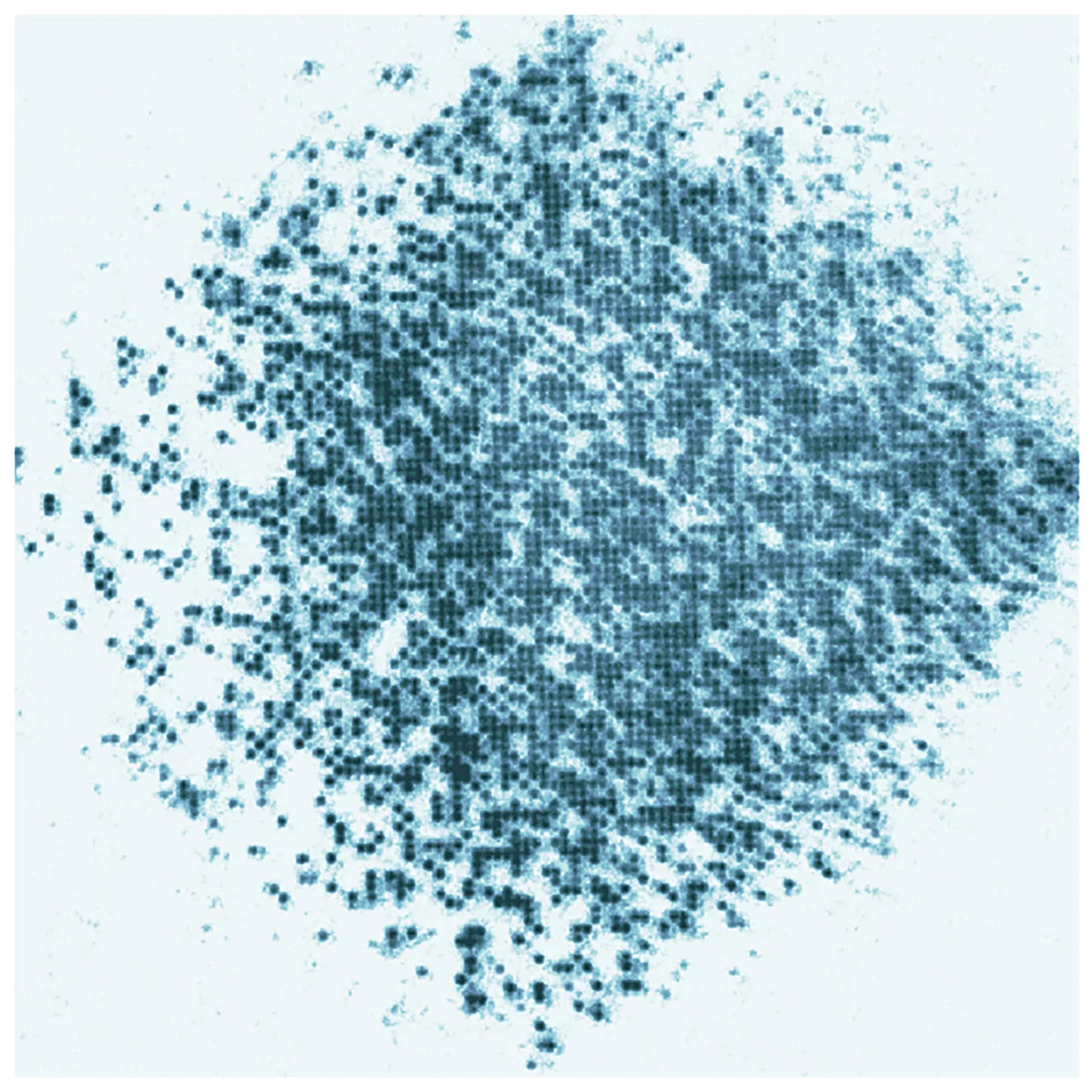
We tested the basic gate operation on our existing lithium quantum gas microscope. An optical superlattice of 532 nm and 1,064 nm light splits each lattice site into a double well, most of them holding one spin-up and one spin-down atom. Lowering the barrier between the wells lets the atoms tunnel and interact, which drives spin exchange and pair tunnelling. Stopping halfway gives an entangling √SWAP gate. Spin- and charge-resolved fluorescence imaging records the outcome in every double well.
The √SWAP gate reaches an average fidelity of 99.75(6) % across 64 lattice sites, and the coherence time of the entangled Bell states is estimated to exceed 10 s. We also demonstrated a proof-of-principle composite pair-exchange gate, a basic operation for simulations of quantum chemistry. The lithium microscope, built for analogue Fermi-Hubbard simulations, can therefore also run digital gates, the combination FermiQP is designed for.
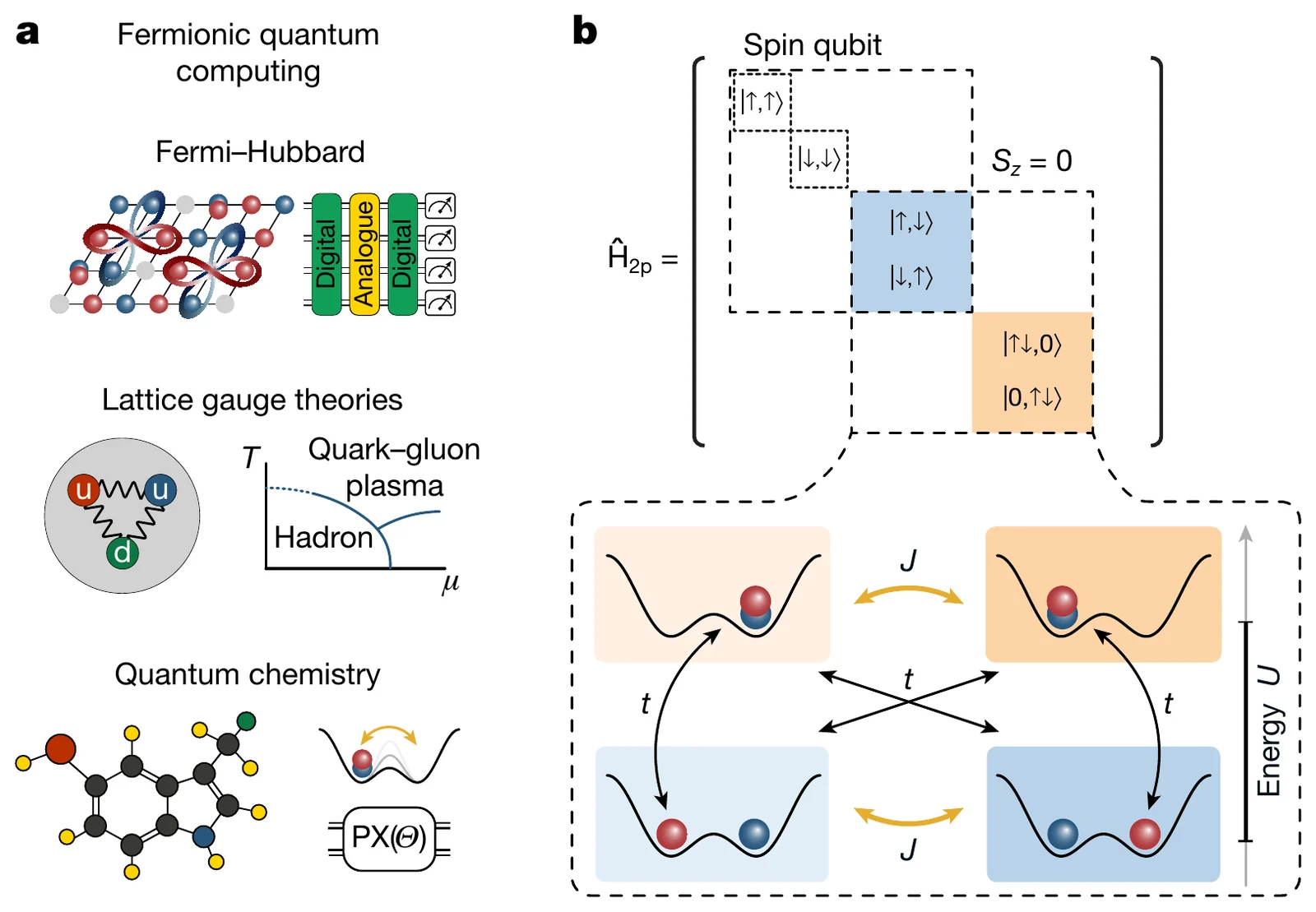 Enlarge (opens the full-size figure)
Algorithms for fermionic hardware
With theory colleagues we design protocols that use the native operations of the hardware. One theory study shows how complex-valued Loschmidt echoes of the Fermi-Hubbard model could be measured, using short pulse sequences on an initial state of 2 × 2 plaquettes followed by a global quench. These give access to spectral quantities such as the local density of states.
A second proposal (PRX Quantum, accepted) treats superlattice tunnelling and site-resolved energy shifts as beam splitters and phase shifters. Following the Clements scheme of linear optics, any single-particle unitary, such as a discrete Fourier transform or an arbitrary coherent rearrangement of atoms, can be built this way. In a preprint we propose how a two-dimensional optical lattice with a projected pattern of repulsive potentials could realise the three-band Emery model in regimes relevant to cuprates and infinite-layer nickelates.
Research directions
Next steps are local addressing of individual atoms, larger systems and longer gate circuits. With these tools we want to prepare and probe strongly correlated fermionic states, for example to study high-temperature superconductivity, and to run fermionic algorithms for quantum chemistry and materials research.
Selected results & publications
High-fidelity collisional quantum gates with fermionic atomsNature 652, 602–608 (2026) · Journal ArticlePhase-Sensitive Measurements on a Fermi-Hubbard Quantum ProcessorQuantum 10, 2103 (2026) · Journal ArticleRealizing the Emery Model in Optical Lattices for Quantum Simulation of Cuprates and NickelatesarXiv:2603.11037 (2026) · PreprintResearch with this team
Discuss student projects, doctoral research or postdoctoral opportunities with the scientific contact; project scope and availability are agreed individually.
Methods and topics: Coherent atom control, Optical superlattices, Quantum algorithms.
Explore research opportunities