
What happens to a Fermi gas when its particles interact through strong, long-range and anisotropic dipolar forces?
The platform
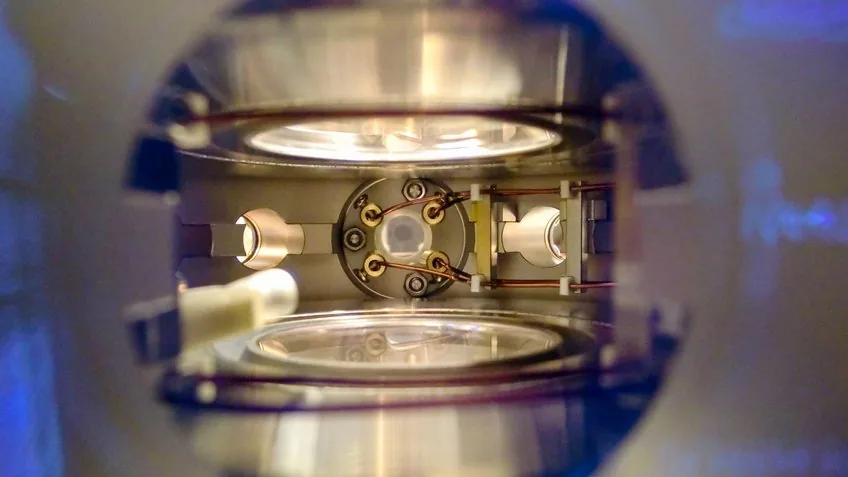
We produce ²³Na⁴⁰K molecules from a quantum-degenerate mixture of bosonic sodium and fermionic potassium atoms. A species-dependent optical dipole trap matches the densities of the two gases. A magnetic field ramp across a Feshbach resonance then forms weakly bound molecules, and stimulated Raman adiabatic passage transfers them to the rovibronic ground state, where they carry a dipole moment of 2.7 debye in the molecular frame. A waveguide antenna 5 mm below the glass cell provides microwave fields of up to 6.9 kV/m with tunable polarisation, and molecules reach one-body lifetimes of up to 10 s. A second, linearly polarised microwave field can be added for double shielding.
A degenerate Fermi gas of polar molecules
Making the molecules starts from a density-matched Bose-Fermi mixture. As we tuned the interaction between the two species, we made observations consistent with a quantum phase transition from a polaronic to a molecular phase: the condensate fraction is depleted and a Fermi gas of molecules emerges. Driving through this transition gives a quantum-degenerate sample of sodium-potassium molecules.
Ground-state molecules are lost quickly once two of them come close. A blue-detuned, circularly polarised microwave field creates a repulsive barrier that keeps them apart and also induces strong dipolar interactions. Elastic collisions can then outnumber inelastic ones by at least a factor of 460, and evaporative cooling brought the gas to 21 nK, or 0.36 times the Fermi temperature.
Field-linked resonances and tetratomic molecules
Conventional Feshbach resonances are not expected in most ultracold polar molecules, because pairs are lost quickly at short range. Microwave-dressed molecules offer field-linked resonances instead, which arise from weakly bound tetramer states in the intermolecular potential. By changing the microwave frequency and polarisation we tuned the inelastic collision rate over three orders of magnitude. A change in the thermalisation rate showed that the resonance tunes the elastic contact interaction independently of the dipolar interaction.
Ramping the microwave polarisation across such a resonance binds pairs of NaK molecules into weakly bound (NaK)₂ tetramers. We created about 1,100 tetramers at 134 nK with a phase-space density of 0.04 and measured lifetimes of up to 8 ms in free space. Dissociating the tetramers with a modulated microwave field let us image the anisotropy of their wavefunction in momentum space.
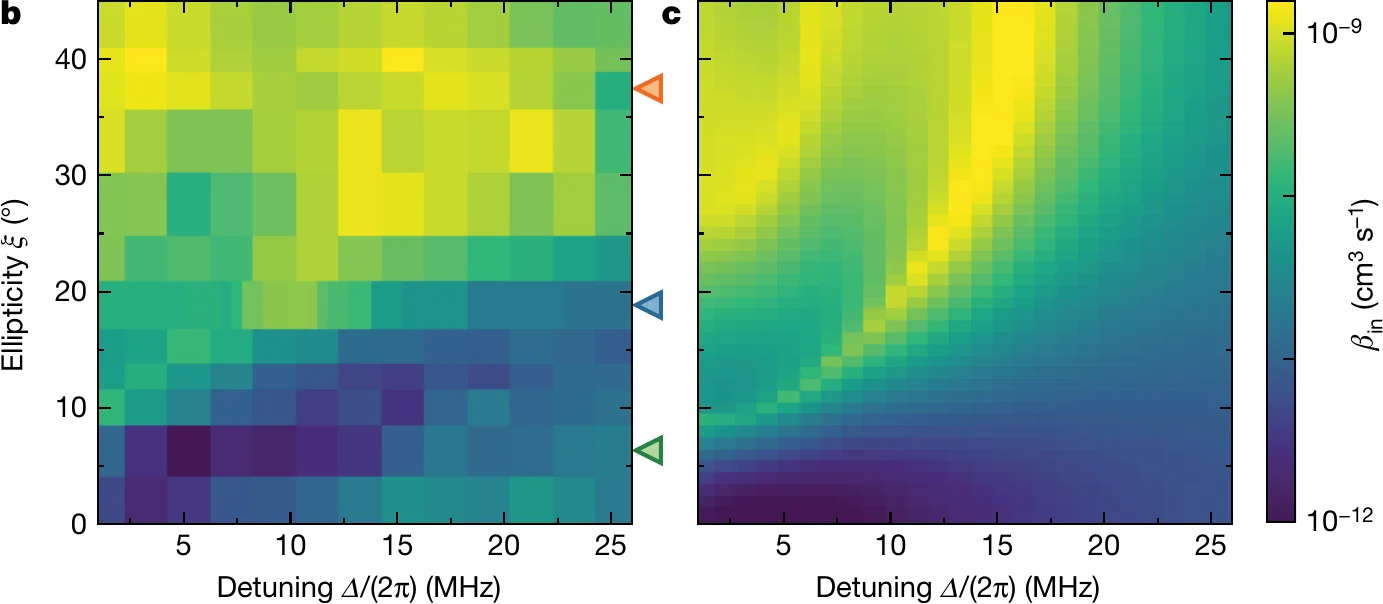 Enlarge (opens the full-size figure)
Dipolar interactions reshape the Fermi surface
In a 2026 preprint we shielded the molecules with two microwave fields, one circularly and one linearly polarised. This reduced inelastic losses three-fold compared with a single field, and we prepared 8,000 molecules at 0.23 times the Fermi temperature. The Fermi surface deformed by up to 7%, a many-body signature of the dipolar interaction. Changing the fields tuned the interaction from axial U(1) to biaxial C₂ symmetry, and the Fermi surface followed. Hartree-Fock theory without free parameters agrees with the data.
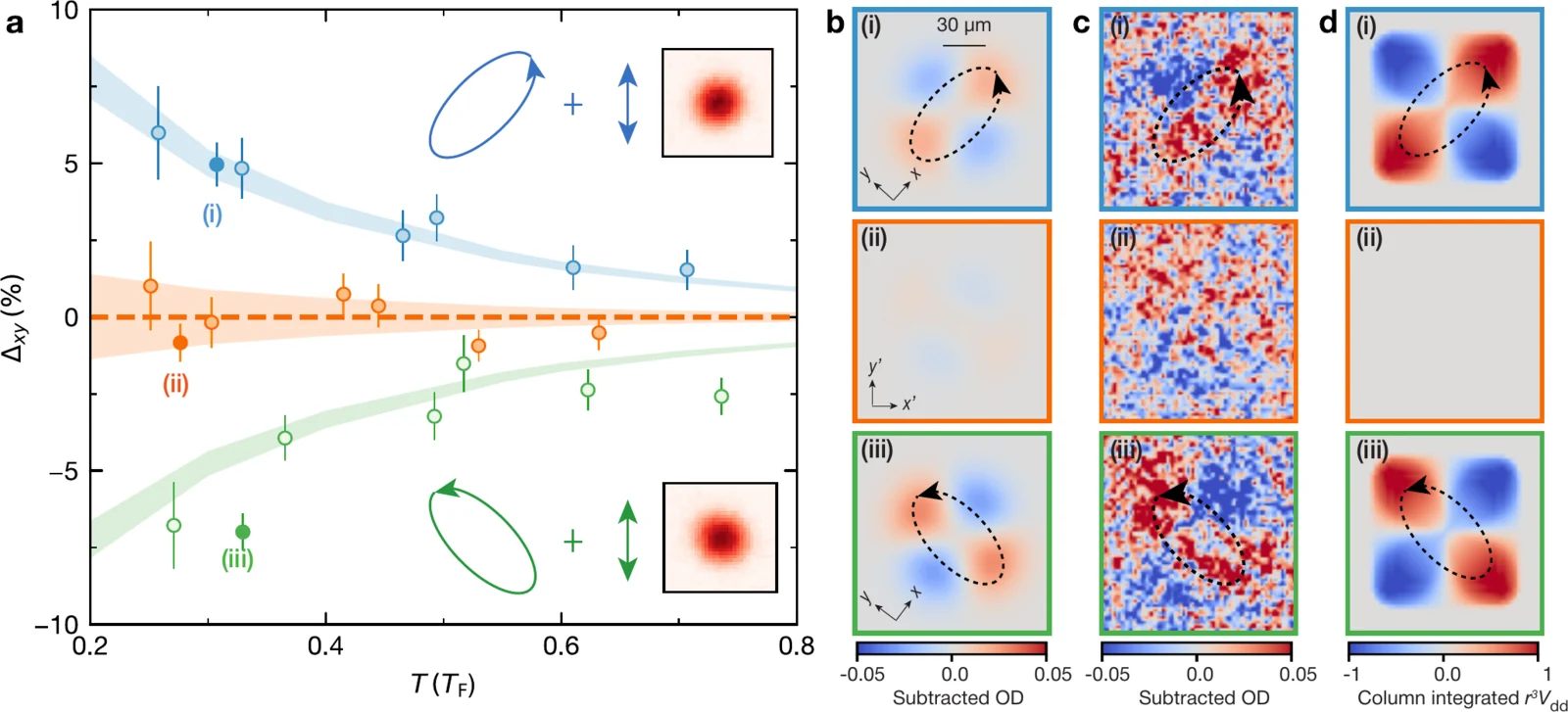 Enlarge (opens the full-size figure)
Research directions
Next we want to reach the p-wave superfluid predicted for fermionic polar molecules, by raising density or interaction strength, and use the tunable interaction symmetry to study transitions between chiral and nematic superfluid phases. Field-linked tetramers offer a second route, towards Bose-Einstein condensation of polyatomic molecules and a crossover from a dipolar BCS superfluid to a condensate of tetramers.
Selected results & publications
Controlled symmetry breaking of the Fermi surface in ultracold polar moleculesarXiv:2602.22447 (2026) · PreprintUltracold field-linked tetratomic moleculesNature 626, 283–287 (2024) · Journal ArticleField-linked resonances of polar moleculesNature 614, 59–63 (2023) · Journal ArticleEvaporation of microwave-shielded polar molecules to quantum degeneracyNature 607, 677–681 (2022) · Journal ArticleTransition from a polaronic condensate to a degenerate Fermi gas of heteronuclear moleculesNature Physics 19, 720–725 (2023) · Journal ArticleResearch with this team
Discuss student projects, doctoral research or postdoctoral opportunities with the scientific contact; project scope and availability are agreed individually.
Methods and topics: Laser cooling, Microwave control, Molecular collisions.
Explore research opportunities