
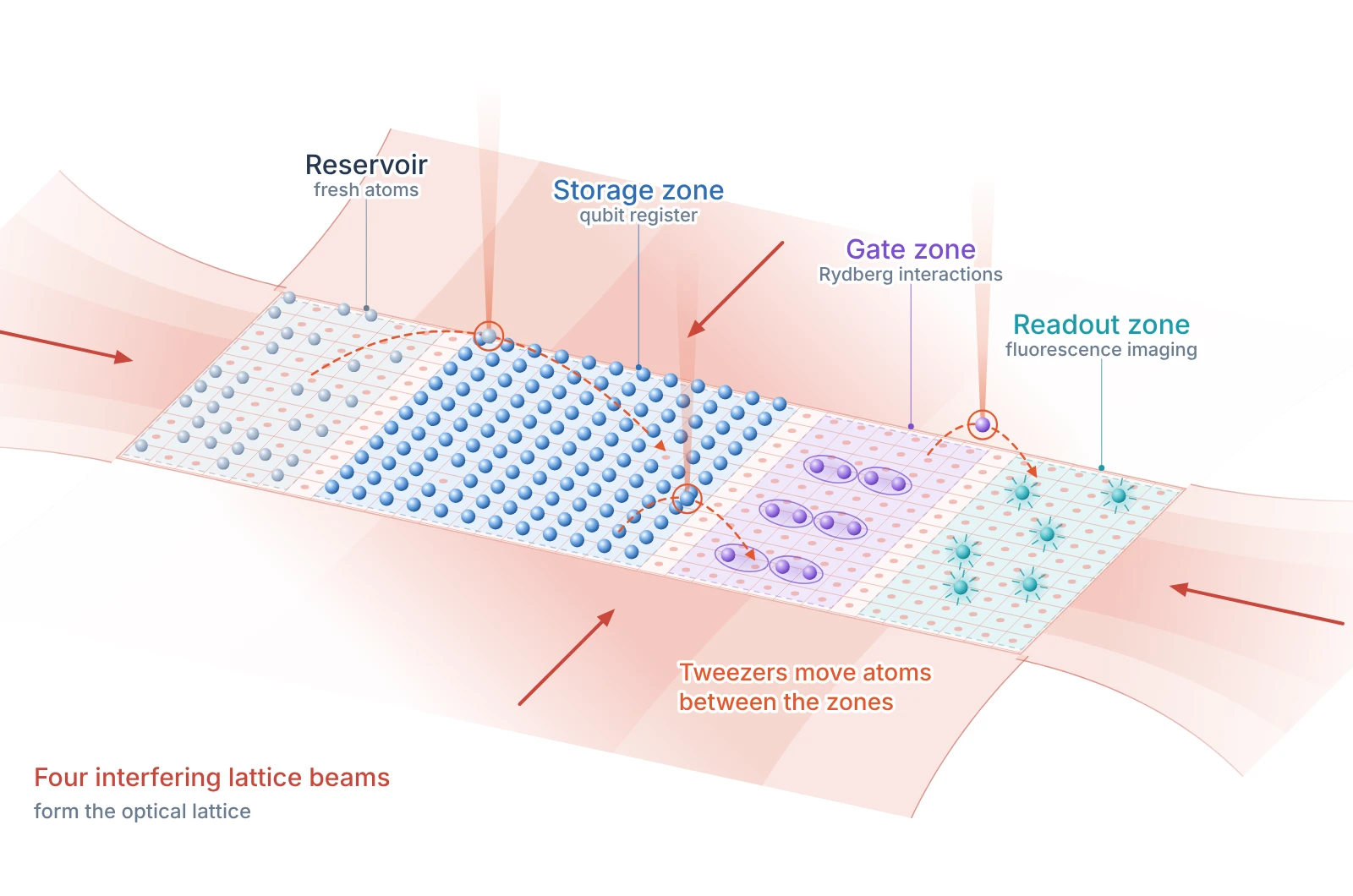
How can ytterbium atoms in optical lattices be turned into large-scale, programmable qubit registers for quantum computing?
Our research
In the Ytterbium Lattice Lab we construct lattice-based qubit registers for quantum computing applications. Optical lattices make much more efficient use of laser power than arrays of individual optical tweezers, which opens the way to considerably larger qubit registers. Movable optical tweezers complement the lattice: they address individual atoms and shuttle them between lattice sites.
In a tweezer array, every trap needs its own share of laser power, meaning that the number of qubits typically grows (sub-)linearly with the available optical power. In contrast, optical lattices create a whole grid of traps at once, offering a route towards substantially larger neutral-atom qubit registers.
Addressing and shuttling atoms with optical tweezers
To address and rearrange individual atoms, we use movable optical tweezers on top of the lattice. A tweezer picks up an atom from its lattice site, carries it to its destination along a path that runs between the occupied sites, so that the atoms already stored in the register are not disturbed, and places it in an empty site. Our group demonstrated this technique with an array of more than 1,000 strontium atoms (Gyger et al., Phys. Rev. Research 6, 033104 (2024)). Focused beams of the same kind can also address single atoms in place, for example to act on one qubit without affecting its neighbours.
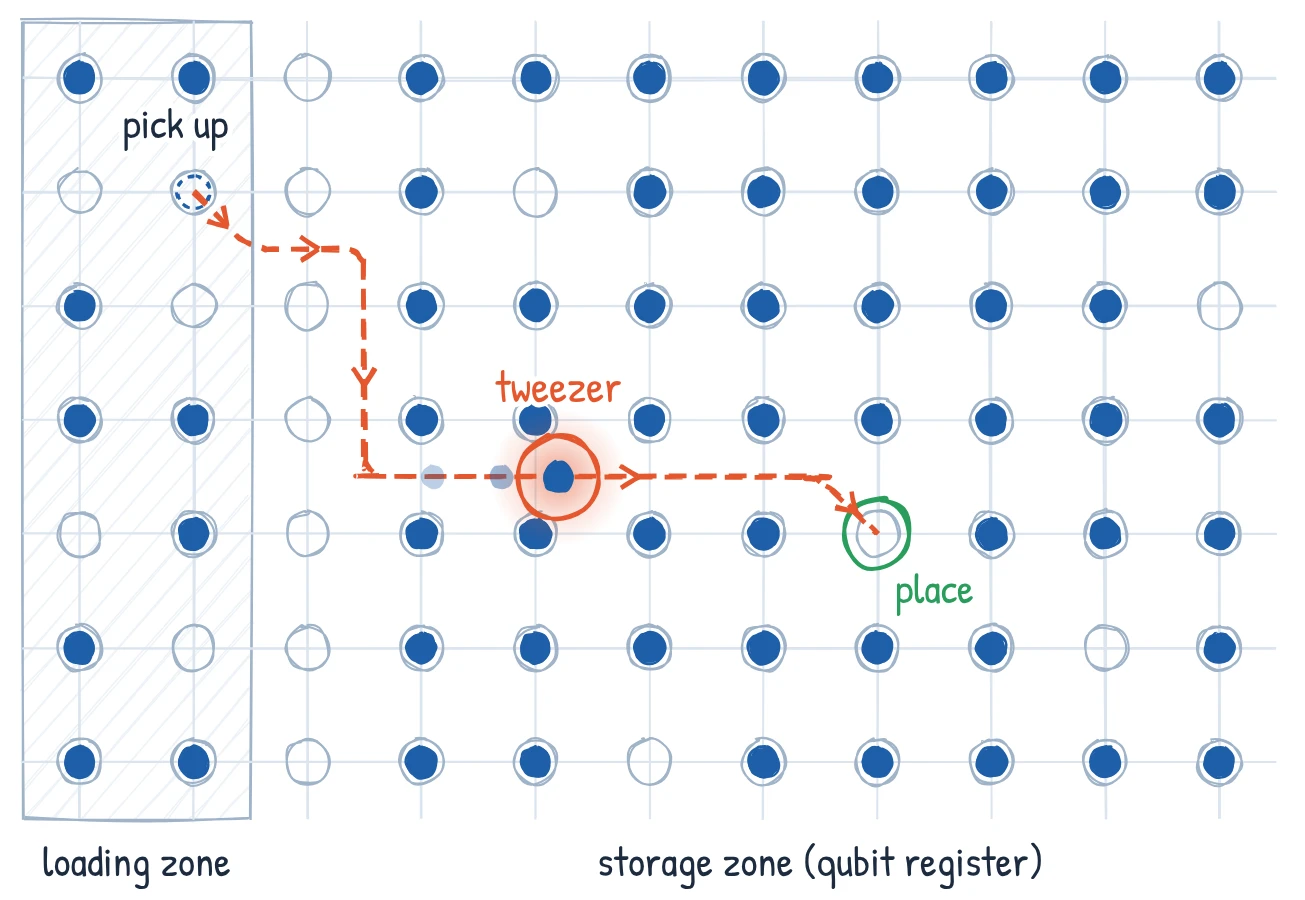 Enlarge (opens the full-size figure)
Resorting atoms in the lattice
Before the atoms can serve as a qubit register, we rearrange them onto the desired sites within the lattice potential: a fluorescence image locates every atom, a computer plans the moves, and the movable tweezer carries atoms into the empty sites of a chosen target pattern. Remaining atoms are kept in a reservoir zone to fill defects on demand. The figure shows a preliminary result of this direct resorting in a lattice, obtained with strontium atoms.
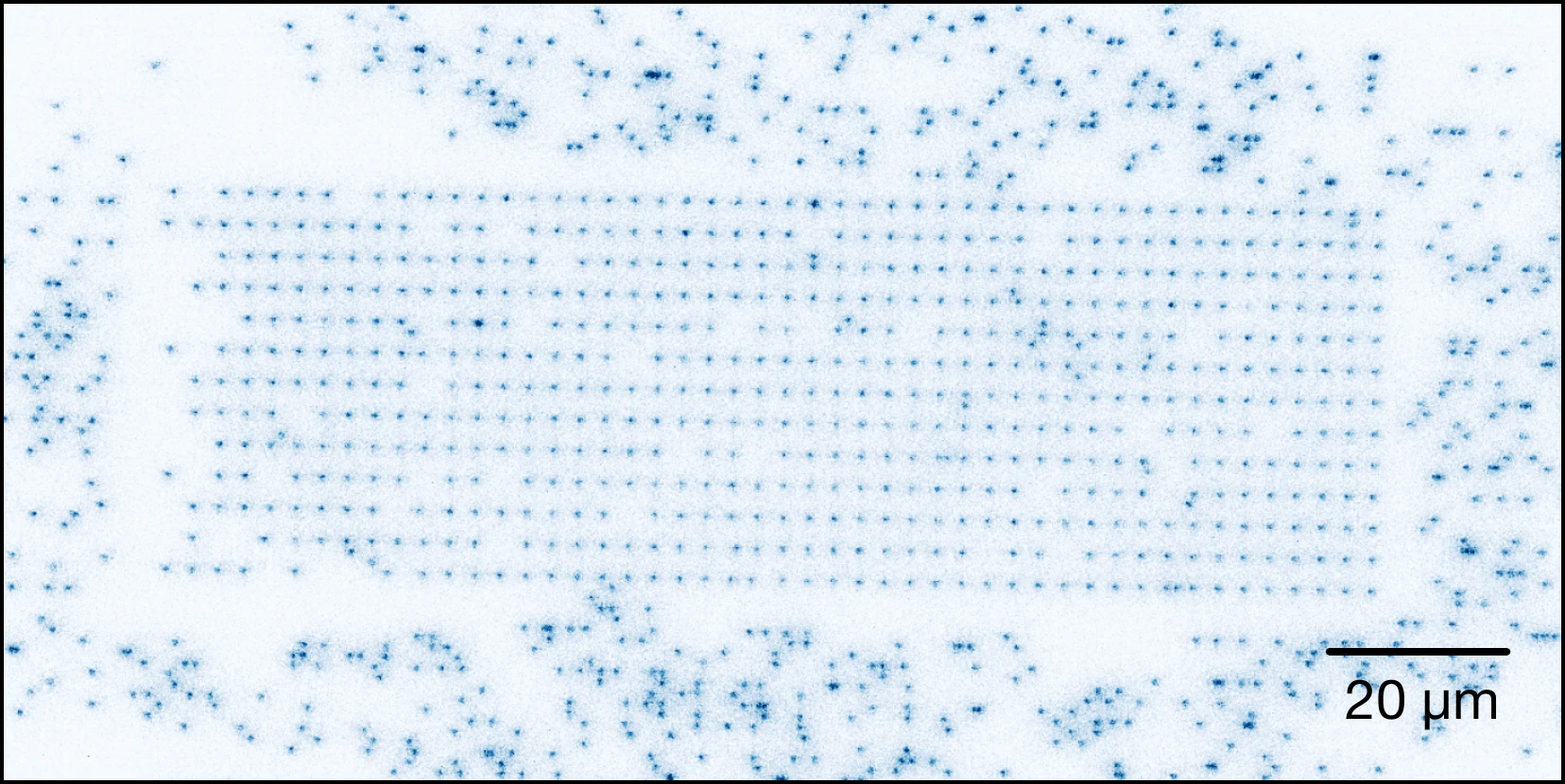 Enlarge (opens the full-size figure)
Towards quantum computing applications
We will divide the register into zones with different tasks, an approach that is increasingly used in neutral-atom quantum computing. A large storage zone in the lattice holds the qubits, while separate zones are reserved for gates and for reading out qubits. Movable tweezers bring atoms from storage into the processing zone and back, so that each operation takes place where the conditions suit it best and idling qubits are not disturbed. A reservoir of fresh atoms replaces atoms that are lost, so the processor can operate continuously.
Research directions
We are building scalable, lattice-based qubit registers that are operated continuously, with lost atoms replaced from a reservoir while the register keeps running. On this platform we will implement single-qubit gates and two-qubit gates based on Rydberg interactions between neighbouring atoms. A large, continuously operated register with these gates will serve as a testbed for quantum error correction.
We have open positions! The lab is just getting started, which makes this a great moment to join: you can help build a new experiment from the ground up and shape where it goes. Whether you are looking for a Bachelor’s or Master’s project, a PhD position or a postdoc, we would be glad to hear from you. Just get in touch to talk about current projects and opportunities.
Research with this team
Discuss student projects, doctoral research or postdoctoral opportunities with the scientific contact; project scope and availability are agreed individually.
Methods and topics: Optical lattices, Optical tweezers, Atom resorting, Single-atom fluorescence imaging, Single-qubit gates, Two-qubit gates based on Rydberg interactions.
Explore research opportunities