

Can a simple cryogenic apparatus hold large strontium atom arrays for hours and turn them into a quantum simulator for XXZ magnets?
The platform
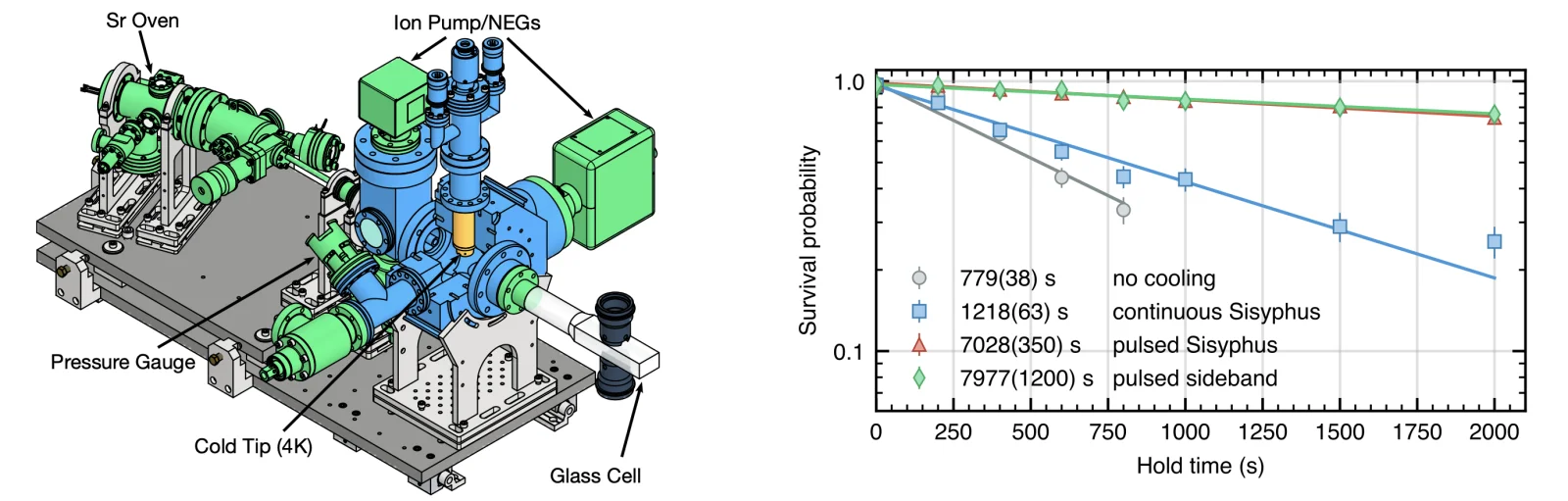
Our apparatus combines a commercial strontium oven, an ultra-high-vacuum chamber made mostly of grade 2 titanium, a fused-silica glass cell and a closed-cycle cryostat. Its cold tip reaches 4 K inside the vacuum, about 30 cm from the atoms. An 813 nm laser and a spatial light modulator form a 16 × 16 tweezer array with 4 µm spacing. An objective with a numerical aperture of 0.65 focuses the tweezers and collects the fluorescence for imaging. All objectives sit outside the glass cell, so we use standard commercial optics.
Two hours in a tweezer
Large atom arrays are assembled by sorting, which takes longer as the arrays grow, so the atoms must stay trapped for a long time. In ultra-high vacuum this time is set mainly by collisions with hydrogen released from the chamber walls. Other cryogenic machines enclose the atoms in a 4 K environment. We instead use a single cold tip about 30 cm away that pumps hydrogen from a distance. The glass cell stays at room temperature, so the objectives sit outside the vacuum with full optical access, and the apparatus remains simple.
With the cryostat running and short cooling pulses, single atoms live in the tweezers for more than 7000 s, about two hours. Because the cold tip is far from the atoms, neither direct nor stray tweezer light reaches it. The lifetime even grows with deeper traps, so we can send in more trapping power without disturbing the cryogenic operation.
 Enlarge (opens the full-size figure)
Scaling up with a bowtie lattice
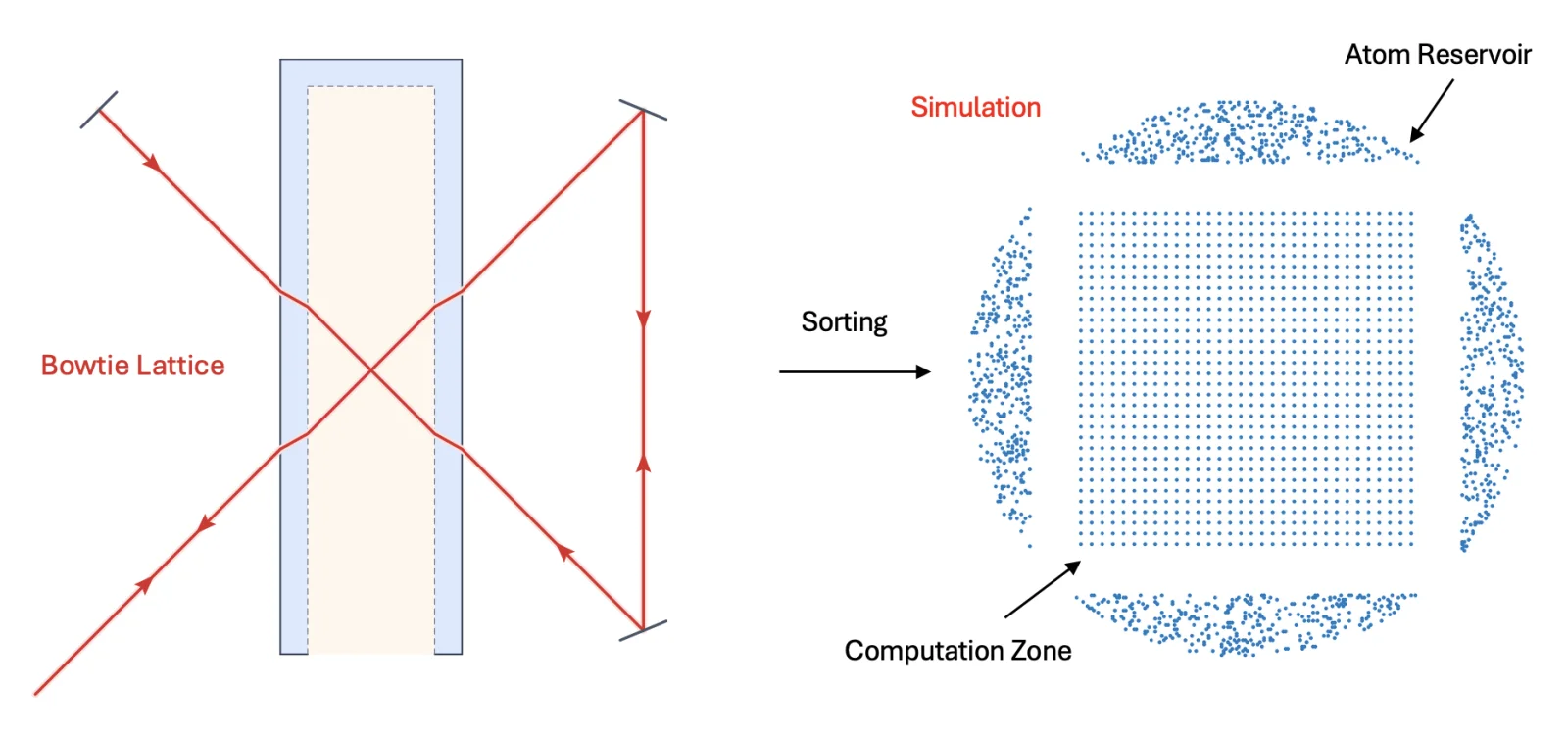
To build much larger arrays, we have added a large optical lattice in a bowtie configuration, in which one laser beam is folded so that it crosses the glass cell twice and forms a two-dimensional lattice. Our goal is to hold about 100,000 atoms while keeping the long lifetimes of the cryogenic system. The image at the top of this page shows atoms in this lattice.
The lattice acts as a stationary reservoir. Movable tweezers pick atoms from it and sort them into a large, ordered array in a central computation zone, where they can be used for quantum computing and quantum simulation.
 Enlarge (opens the full-size figure)
Circular Rydberg states for XXZ magnets
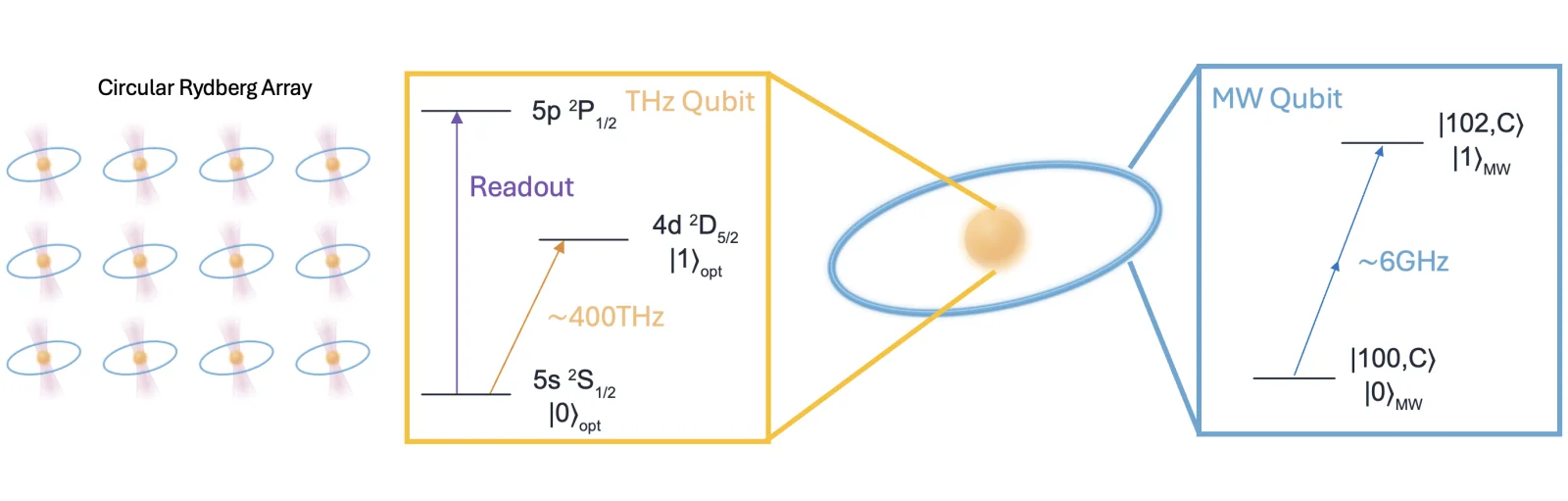
With these tools we plan to build a large-scale quantum simulator for the XXZ spin model. The spins are circular Rydberg states, in which the outer electron moves on a large circular orbit with the maximum possible angular momentum. Atoms in these states interact through strong exchange, which gives rise to the XXZ couplings.
Strontium has two valence electrons. When one is promoted to a circular orbit, the other stays with the ion core and keeps its own optical transitions. Because the circular electron never comes close to the core, the two can be controlled independently: the Rydberg electron stores a microwave qubit, and the core electron reads it out optically, atom by atom.
Circular Rydberg atoms are also promising for quantum computing. Each atom carries a microwave qubit, in the frequency range of superconducting qubits, and an optical qubit on the ion core, in the range used with trapped ions and neutral atoms, so it can act as a bridge between the two.
 Enlarge (opens the full-size figure)
Research directions
A next step is to enlarge the area held at 4 K, for example with a shield on the cold tip or activated charcoal, which should extend both the lifetime and the time between regenerations. Long storage without cooling should let us keep atoms in the metastable ³P₀ and ³P₂ states for longer. With more time for sorting, we expect to assemble defect-free arrays of several tens of thousands of atoms. The open optical access leaves room for large-field-of-view objectives.
Selected results & publications
A cryogenic neutral-atom platform with full optical access and 2-hour trap lifetimearXiv:2607.12988 (2026) · PreprintResearch with this team
Discuss student projects, doctoral research or postdoctoral opportunities with the scientific contact; project scope and availability are agreed individually.
Methods and topics: Cryogenic vacuum systems, Optical tweezers, Optical lattices, Circular Rydberg states, Strontium laser cooling, Single-atom detection.
Explore research opportunities